circuitwaste

The cold summer suppressed the odors
Students who completed their specialization training as waste sorting researchers in Sammakkokangas praise the cool summer: only a few fly larvae were visible in the garbage bags.
'PThe worst smelling garbage bags are those containing packages of grilled marinated meat. Often there are baby diapers in the same bag. Mashed potatoes smell both spoiled and fermented. Macaroni and rice also smell. Adult ammonia diapers are bad.”
"You get used to the smells. But sometimes the bags are so bad that you could almost sleep through the night. Neither of us has vomited yet."
Students studying agronomy at Jyväskylä University of Applied Sciences, Saarijärvi Tarvaala Bioeconomic Institute Siiri Niiranen ja Pine Leaf have completed their 15-credit specialization internship at the Sammakkokangas Waste Center. From the beginning of May to the end of June, their job was to open randomly selected garbage bags collected from the Sammakkokangas and Mustankorkea urban and sparsely populated areas and examine what was inside them. The students sorted every single piece of garbage found in the bags into 28 fractions according to the Waste Management Association's research guidelines and weighed how much of each type was in the bags.
The research is part of the Circwaste sub-project coordinated by the Central Finland Regional Council, which maps the region's waste streams and investigates the composition of waste streams and people's sorting accuracy.
As we write this story, it's Midsummer's Eve. Niiranen and Lehti are preparing to open the next load of bags in the sorting hall of the Sammakkokangas waste center in Saarijärvi.
"We are grateful that the summer has been cool because the garbage hasn't smelled so much. As soon as it's been a warm day, you notice it: The amount of mold increases, blue dust comes out of the bags, and there are even fly larvae in the garbage."
This summer, the air was sometimes so cool that the breath in the warehouse that serves as a sorting hall in Sammakkokangas was foggy and it was snowing outside.
The beanie protects against ATV riders
The students are well protected. The respirators encourage breathing through the mouth. They are wearing safety shoes with safety toes and a plastic protective coverall. They are wearing puncture and cut-resistant gloves and disposable latex gloves on top of them to prevent moisture from getting through immediately. Both are wearing beanies.
"So that you don't always feel like there's a bug crawling along your scalp."
Once or twice a day, students collect a 600-liter container of garbage bags from the sorting field, which an excavator has randomly selected from a large load. They empty the container onto a tarpaulin and lift the bags one by one onto the sorting table to be opened. With a quick flick of the wrist, the garbage flies into one of the 28 containers waiting on the table, which are weighed regularly.
The girls have been helped in their sorting work not only by the research guidelines prepared by the Waste Management Association, but also by the CEO of Sammakkokangas. Outi Ruuska, who guides students in their internships, as well as waste advisors Mia Rahinantti.
"First, we sorted a practice load. That was absolutely important. It showed the sizes of the containers and other things that were needed to make the actual research sorting go quickly," the students say.
“The most difficult category in the study has been other hazardous chemicals. For example, half a bottle of dishwashing detergent falls into that category. You might not think of it as hazardous, but it is a detergent.”
The Nova radio, played by a radio retrieved from an electrical waste bin, echoes on the warehouse table. The girls stand at the sorting table, their hands moving quickly.
"The main point of coziness is that there is a couple. You couldn't do this alone. We reflect on the deep things that happened. You can approach the daunting task with a strong sense of humor, and the worst things will pass more quickly."
The bags contain the entire spectrum of human life.
"In the first week, I was greeted with a bag of underwear and a fake vagina."
“Sort it out, people!”
Niiranen and Lehti have noticed that people on average do not sort their waste very well. Almost every bag contains something that has been missorted. There are a lot of batteries in household waste, as well as biowaste.
"There has been usable food in the waste, in unopened packages. I knew the situation was bad, but not that it was this bad," Niiranen laments.
"The side of the waste bins should read: Sort your waste now, s***!"
Of course, there are those who sort conscientiously, but these are a minority.
"If the first thing you find in the bag is a milk bottle cap, you know that this bag has been sorted well," Lehti has noticed.
The owner of the trash will survive.
"Here you realize that everyone's contribution matters. Sorting is not a trivial task. I wasn't a two-way sorter myself before, but now I take it more seriously. If I used to throw a carrot head in the mixed waste, I don't anymore. And I don't buy unnecessary food anymore," Lehti says.
While conducting sorting research, the girls have noticed another surprising thing.
"Usually, every garbage bag contains something that identifies the owner of the bag. Sometimes, a child's school photos, health nurse questionnaires or tax cards have been found in the bags," Niiranen says.
To work in the industry
Sammakkokangas and Mustankorkea will be able to utilize the results of the sorting research in their own advisory and planning work.
"In this job, you immediately reach the so-called 'top of your career' when you get to do composition research. Not everyone is there for this. This will certainly be useful for the future, because this involves such concrete work. You have to understand a lot about sorting," describes Outi Ruuska, CEO of Sammakkokangas, who supervised the students in the research.
Both girls say they learned a lot about waste management while conducting sorting research and believe that the experience will be useful in the future.
"I have planned to pursue further studies in environmental management. Through my internship, I have learned how much this work means. I see myself working in this field in the future," Pinja Lehti summarizes.
"My interest in waste management has grown. I've always known that waste management is important, but now it and the entire circular economy are even more interesting. I wouldn't see any reason why I wouldn't work in this field someday. This is really important work. It's good if it makes even one person think about these things," Siiri Niiranen sums up. 
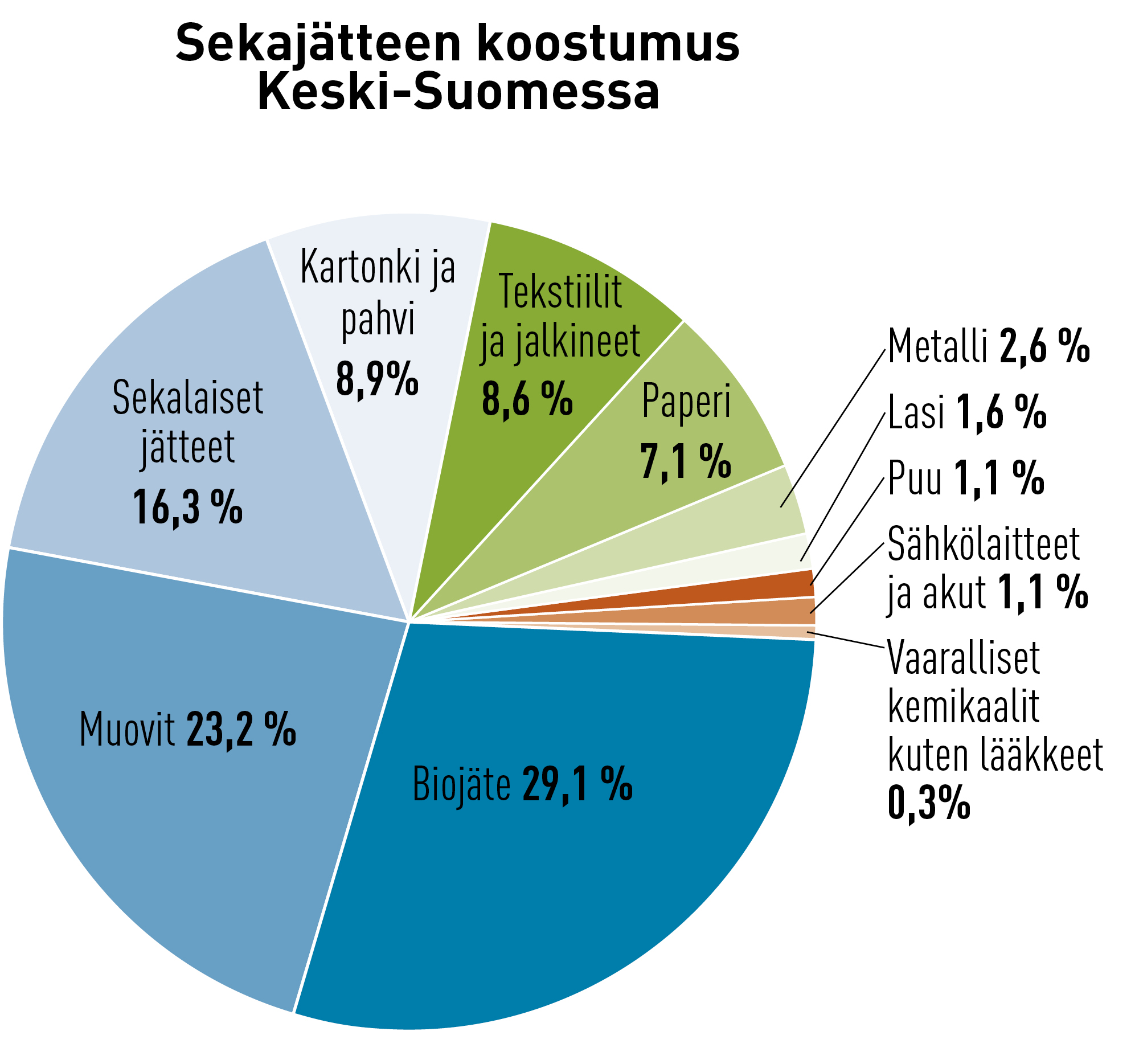 Mixed waste comprised a total of 30,1 percent packaging waste. The majority of this was plastic packaging. The figures are the combined average values of the mixed waste bags in the rural and urban areas studied. Source: Circwaste subproject Central Finland, 2017.
The fuel equivalent of 500 gas cars is burned as mixed waste
In Central Finland, so much biowaste ends up in the wrong disposal along with mixed waste that the fuel equivalent to the annual consumption of 500 biogas cars is wasted.
Elina Saarinen
In the Jyväskylä region A total of approximately 5 tons of biowaste ends up in mixed waste bags each year, even though this biowaste should be sorted separately into biowaste. Once it ends up in mixed waste, the biowaste is taken to Tampere to be burned in a recovery power plant. There, moist biowaste causes corrosion, and burning aqueous biowaste does not make sense from an energy production perspective.
If biowaste were sorted correctly, into biowaste containers, it could produce approximately 5 gigawatt hours of biogas at the Mustankorkea biogas plant. This amount corresponds to the annual fuel requirement of approximately 500 gas-powered passenger cars.
This summer, the Regional Council of Central Finland commissioned a study as part of the Circwaste sub-project to find out what kind of waste is found in the mixed waste bags of Central Finns. The contents of the waste bags were studied in two areas of the Mustankorkea and two areas of the Sammakkokangas waste centres: in urban areas in Kuokkala and the centre of Saarijärvi in Jyväskylä, and in sparsely populated areas in Kannonkoski and Kivijärvi, as well as in Korpilahti.
All areas studied have a mandatory separation of biowaste. Despite this, up to 30 percent of mixed waste was biowaste.
Barbecue season was in sight
According to the study, an estimated 14-19 percent of mixed waste is waste that falls under the definition of mixed waste. Such waste includes, for example, bandages, diapers, rock, dirty and non-recyclable packaging and plastics, broken textiles, bones, and light bulbs.
Packaging made up 30% of the waste, mainly plastic packaging. In the Central Finland region, separate collection of plastic packaging is still limited, so plastic packaging can be placed in mixed waste. Plastic accounted for a quarter of the mixed waste.
The study was conducted at the beginning of the barbecue season, which was reflected in the fact that there were, for example, unopened sausage packages in the mixed waste. Midsummer, on the other hand, was reflected in the number of cans without deposits.
The share of electrical appliances and batteries was around one percent. Sometimes, entire electrical appliances in plastic bags, such as game consoles and Christmas lights, were found among the mixed waste.
Hazardous waste such as medicines was also found in bags among the mixed waste. Agricultural pesticides were also found.
Usable textiles were also found in the mixed waste, some with price tags still attached.
An average of 129 kilograms of mixed waste is generated per inhabitant in the Mustankorkea area. An average of 184 kilograms of mixed waste is generated per inhabitant in the Sammakkokangas area.
The study was part of the Circwaste sub-project coordinated by the Central Finland Regional Council, which receives funding from the EU's LIFE programme. Other funding sources include Mustankorkea Oy, Sammakkokangas Oy and Gasum Oy.
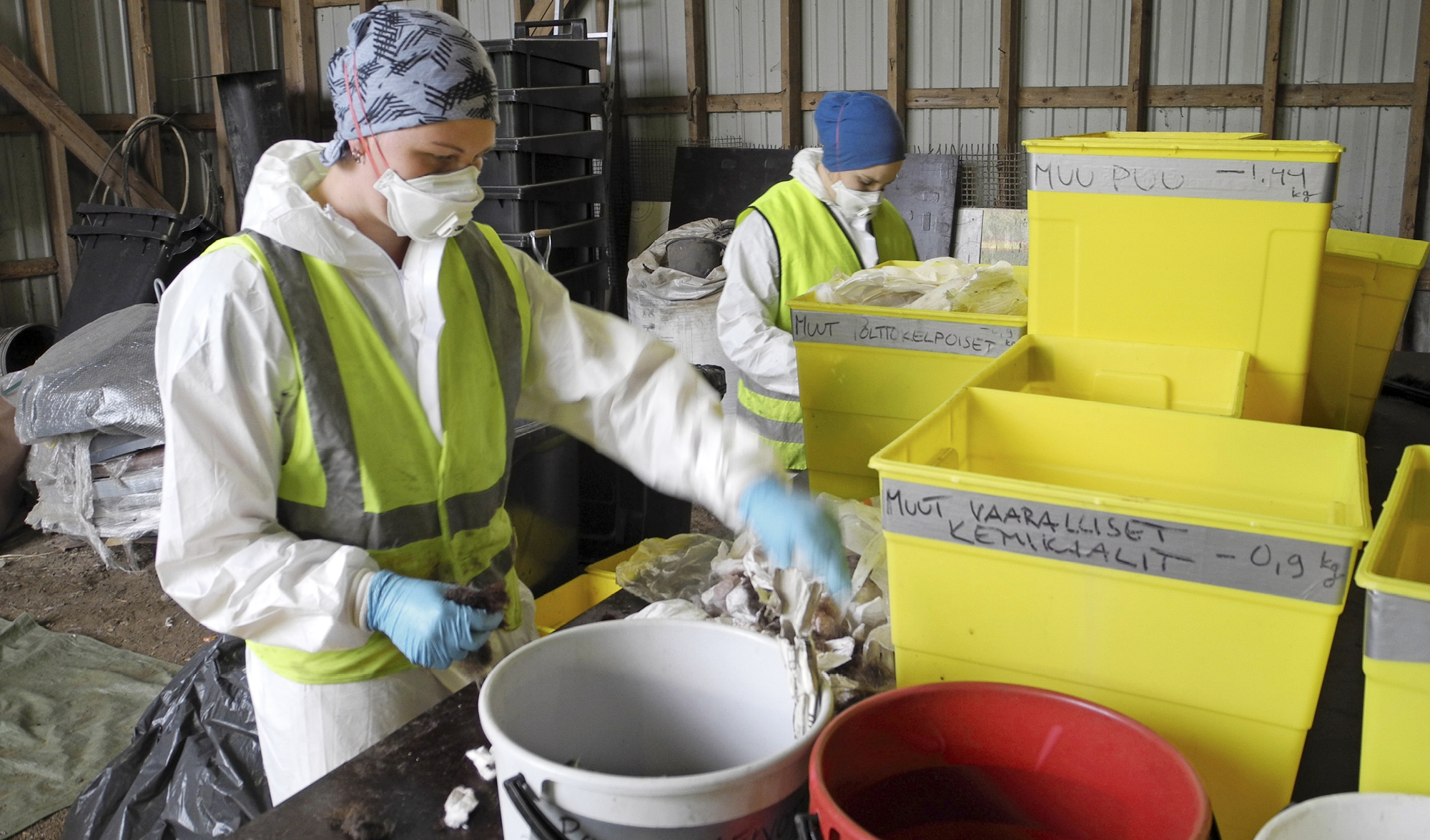 In the sorting study, the contents of the garbage bags are sorted into 28 fractions. Each has its own container on the sorting table, and the contents are weighed. This way, we can find out what types of waste are most prevalent in the mixed waste.
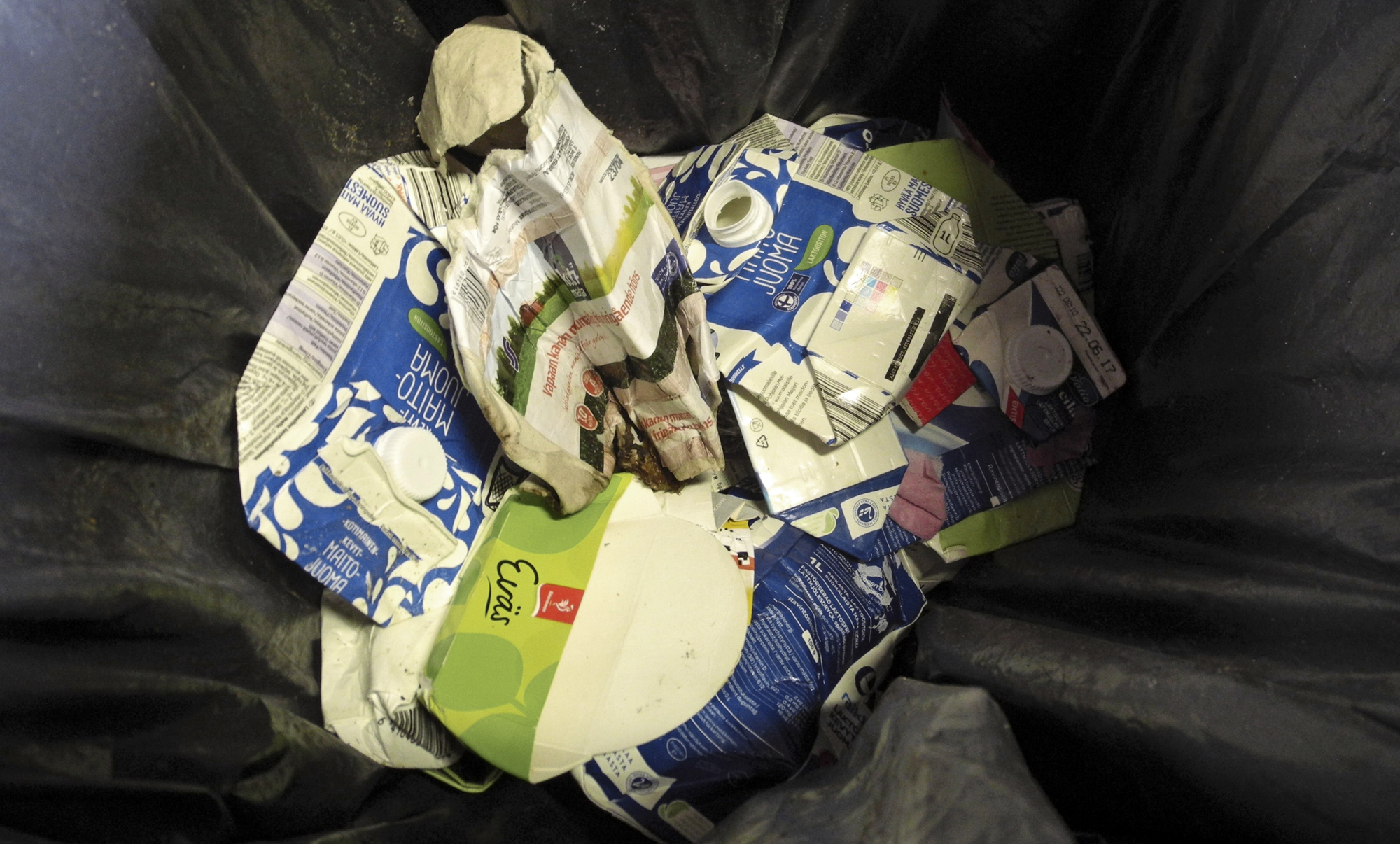 Carefully flattened cardboard packages have been found in garbage bags, but they have not been taken to the cardboard collection container.
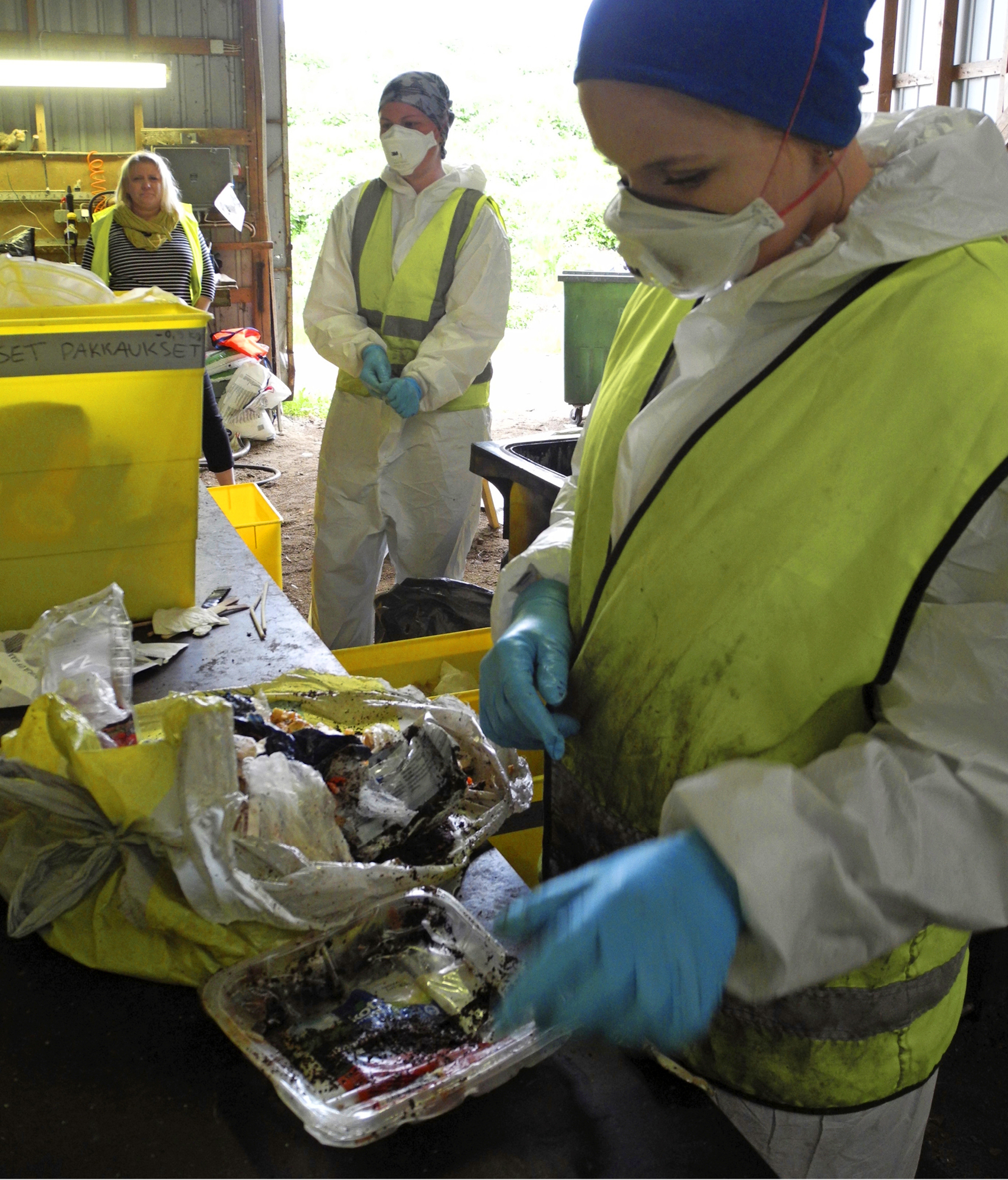 Respirators are needed. The lumpy meat and marinade residues stink. Outi Ruuska is watching the work in the background.
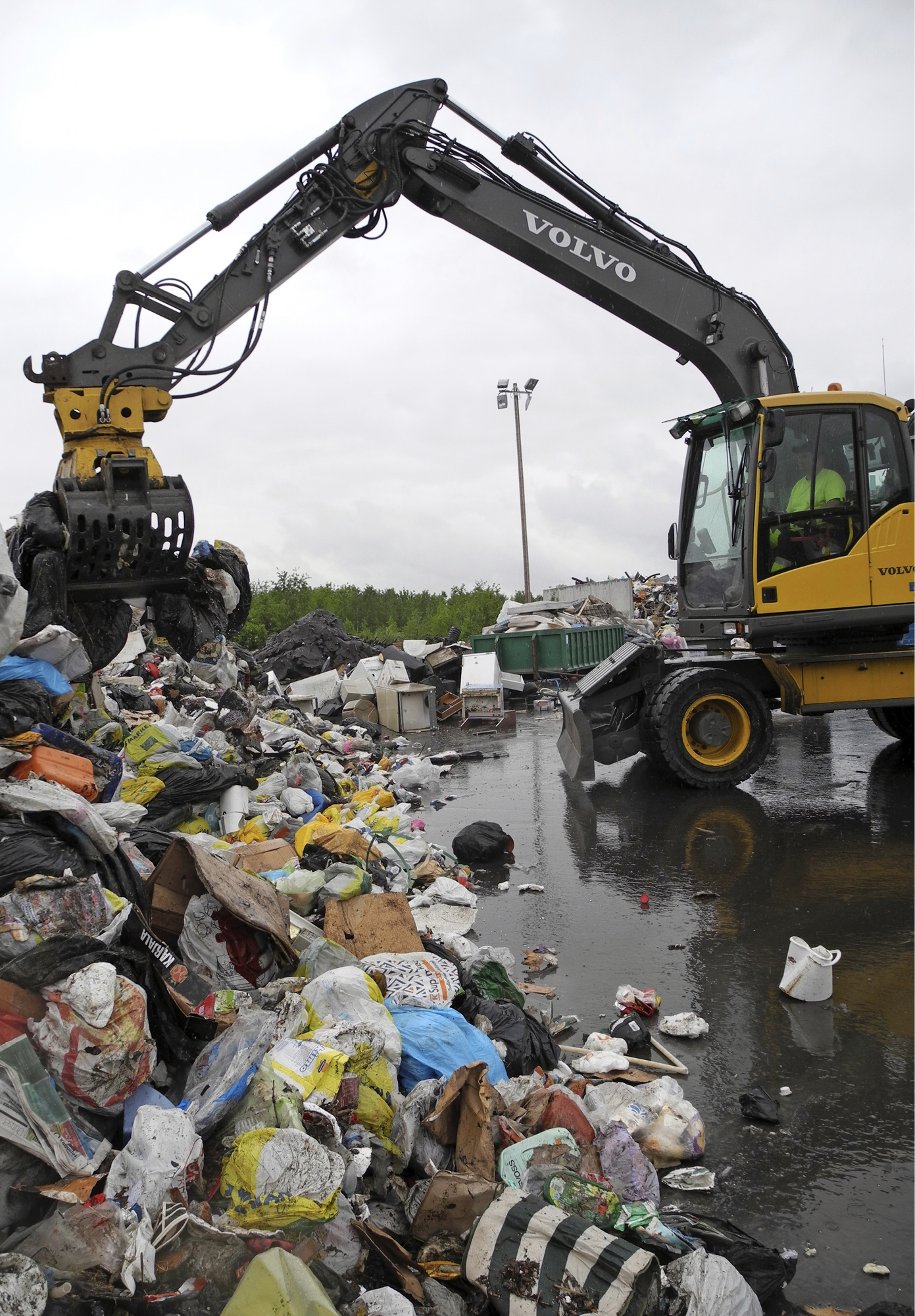 A random sample of 600-liter garbage bags is taken from the newly delivered waste load. The excavator mixes the pile of garbage bags so that the waste from one housing association is not overrepresented in the study.
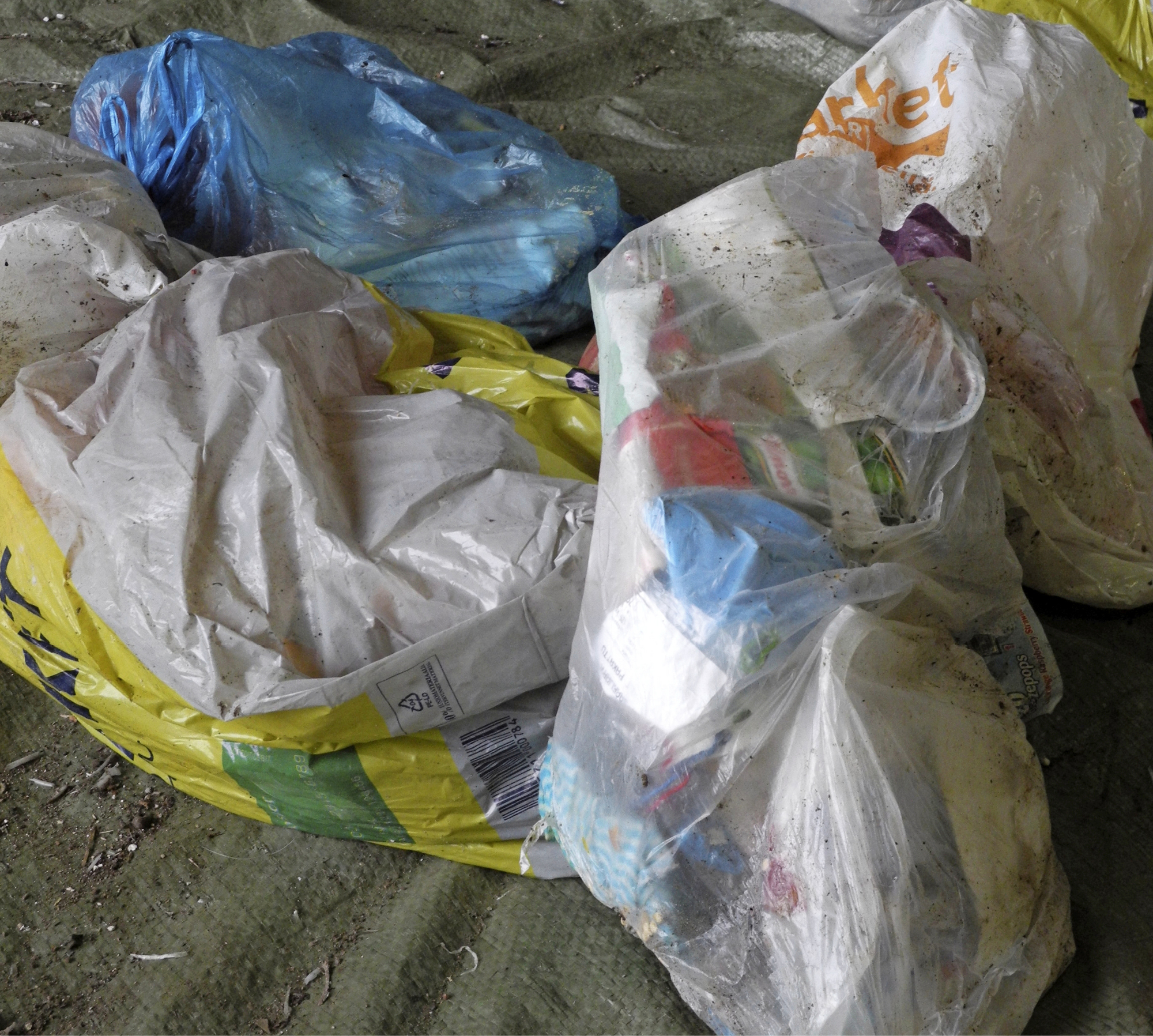 The garbage bags have been lifted from the trash can onto a tarp waiting to be opened.
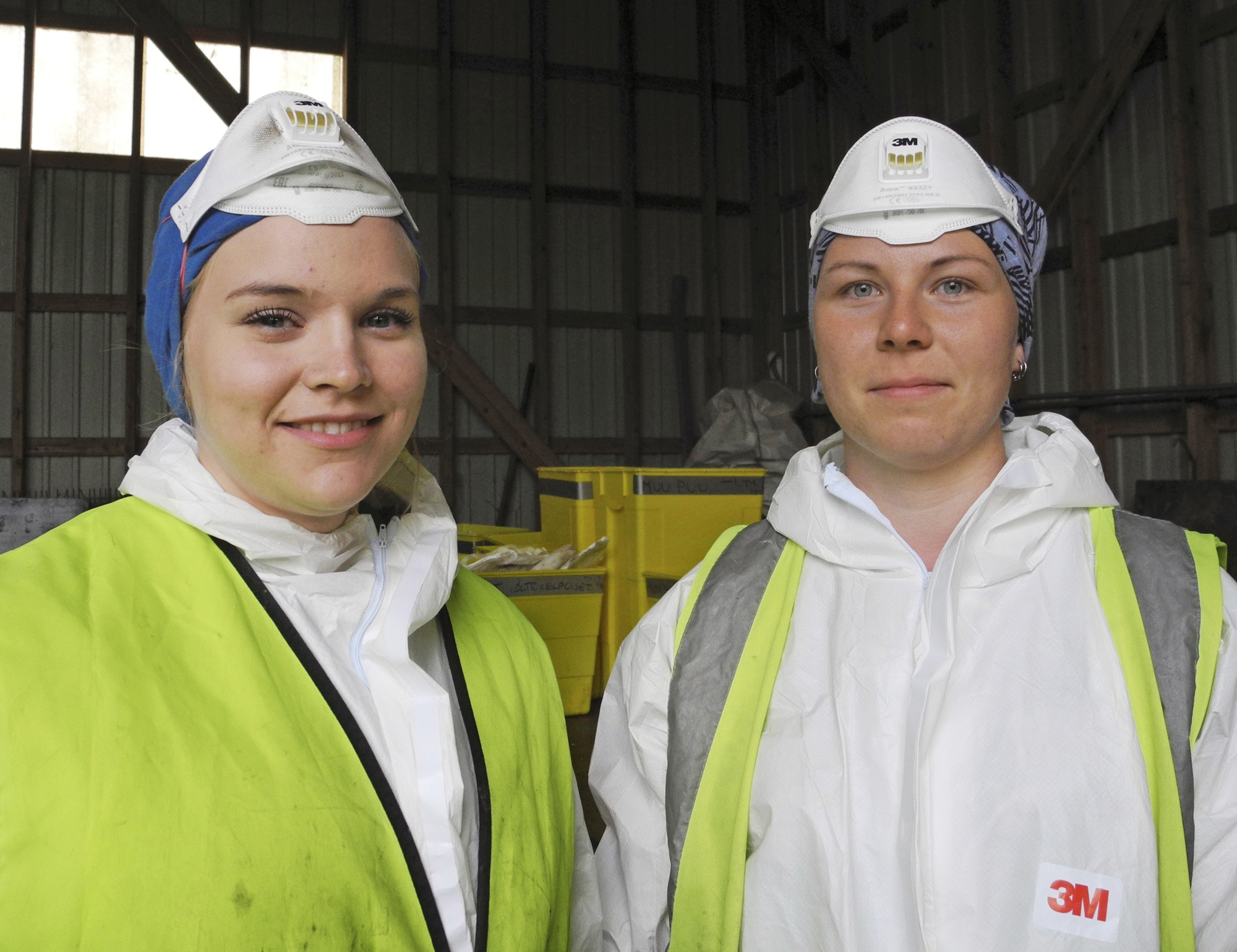 Pinja Lehti and Siiri Niiranen say that conducting sorting research has increased their interest in the waste management and circular economy sectors so much that they could even find a future profession in the field.
 The bag revealed a pile of hair. Sorting hair from coffee grounds and shredded paper is a time-consuming task. Is there a garbage bag from a barbershop? Due to secondary waste management responsibility, waste also ends up in Sammakkokangas's load from many SMEs that have not received any other waste management service from the market.
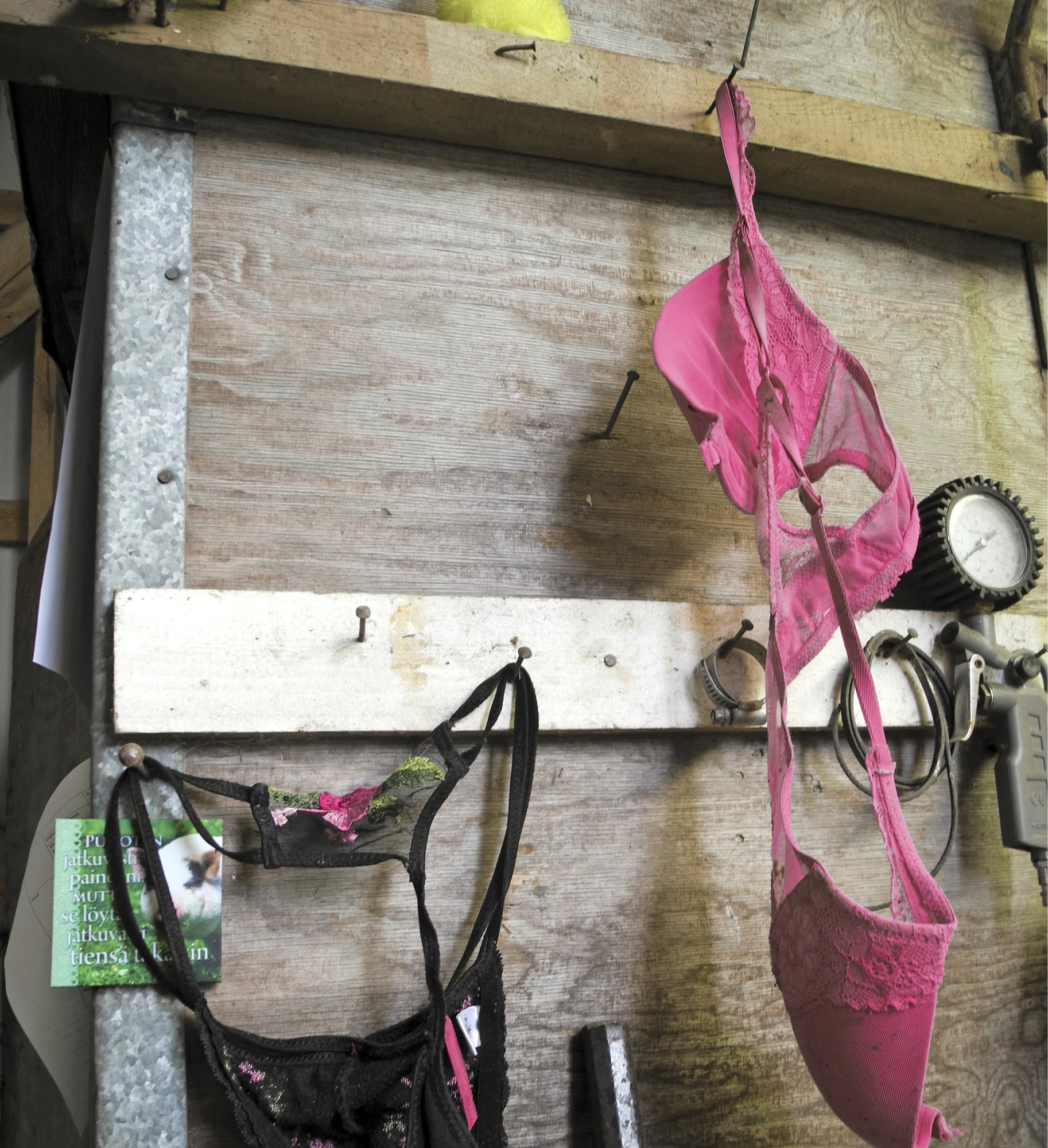 The entire spectrum of human life can be found in garbage bags. The lace-covered ones were able to decorate the walls of the Sammakkokangas warehouse.