COMMERCIAL COOPERATION At the beginning of 2026, a two-year Wood Construction Development Platform project was launched, in which Eastern Finnish universities of applied sciences combine their expertise to develop wood construction. The project strengthens expertise,…
DC NEST supports the emergence of sustainable data center ecosystems



COMMERCIAL COOPERATION
Uusiouutiset blog
Demand for digital infrastructure is growing at an unprecedented pace worldwide. At the same time, northern, more remote regions are increasingly being targeted for significant investment. Data centers and other energy-intensive industries are seeking locations in areas with abundant renewable energy potential, cool climates, and available, often cheap, land.
While the development offers significant opportunities for economic growth and investment, it also raises important questions about sustainability, energy use, local benefits, and long-term regional planning.
The Data Center NPA Ecosystem (DC NEST) project, funded by the Interreg Northern Periphery and Arctic programme, has been launched to help municipalities and regional actors respond to the opportunities and challenges of this rapidly growing sector. The project aims to strengthen the expertise of authorities and stakeholders and support sustainable data center development across the In the NPA area.
Preparing for the digital transformation
The rapid growth of cloud services, artificial intelligence and digital services is increasing the need for data centers internationally. For northern and sparsely populated regions, this development is an opportunity – data centers can create significant opportunities for attracting investments, creating new jobs and strengthening local economies and innovation environments. However, all this requires local authorities to be able to assess the environmental impacts of investments, exploit the opportunities of renewable energy, manage energy needs and ensure that projects create real benefits for local communities. Without good spatial planning, a data center ecosystem will not be created.
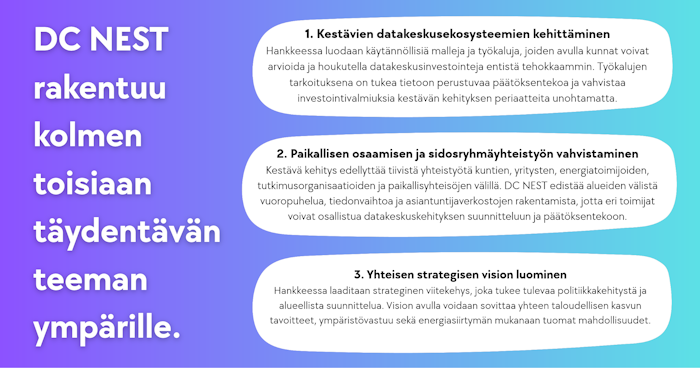
DC NEST was created to meet this need. The project develops municipalities' capabilities to assess, attract and guide sustainable data center investments, produces practical tools, strengthens local expertise and creates cooperation networks between regions.
International cooperation enables multidisciplinary
The DC NEST project is coordinated from Finland, Kajaani University of Applied Sciences, CSCand KDCE, and its partners are the Irish European Regions Network for the Application of Communications Technology (ERNACT), the Icelandic South Iceland Municipality Association, and Umeå University from Sweden. From Norway, the project is being supported by UiT The Arctic University of Norway.
Multidisciplinary and international cooperation enables the sharing of experiences, expertise and best practices between different regions. The aim is to develop solutions that can be widely utilized throughout the project area and regional organizations.
Practical tools to support municipalities
One of the key results of the project is the development of concrete tools and operating models for use by municipalities.
These include, among others:
- Sustainable Data Center Development Toolkit (Sustainable Data Center Development Toolkit)
- Support for local capacity and competence development (Local Capacity Building Framework)
- Regional sub-strategies and policy recommendations
- A common NPA strategic vision for developing data center ecosystems
These tools allow municipalities to assess the environmental impacts of investments, identify opportunities for utilizing renewable energy, examine economic and social impacts, and design innovative solutions, for example for utilizing waste heat and smart energy management.
Opportunities for northern and sparsely populated areas
A particular strength of the so-called Northern Periphery and the Arctic region is its potential to provide energy-efficient operating environments for data centers. The cool climate reduces the need for cooling, and the growing production of renewable energy enables the construction of low-carbon digital infrastructure.
DC NEST highlights these regional strengths and helps municipalities utilize them in a sustainable way. The project aims to ensure that data center investments support local well-being, strengthen business and promote environmentally responsible development.
As an example of direct support from data center ecosystems to the local community, one could use XTX Markets donates one million euros to the city of Kajaani, with which the company supports the development of data center expertise at the local university of applied sciences and the city's resident-oriented activities.
A look at the project's aftermath
DC NEST, which will be implemented from September 2026 to February 2029, is an important step towards sustainable and competitive data center ecosystems in the municipalities in the project area.
Through collaboration, information exchange and practical development work, the project helps regions prepare for the growth of data infrastructure and utilize the opportunities it offers in a responsible manner.
Over the coming years, DC NEST will produce new insights, tools, and strategic recommendations that will help the northern regions build a more sustainable, smarter, and vibrant future.
Text: Ella Lukkari and Outi Laatikainen, KAMK
Image: DC Nest project. DC Nest develops sustainable data center ecosystems, strengthens local expertise and supports collaboration.
More on the topic

Uusiouutiset newsletter