
Those who follow the international discussion of the circular economy have often had to agonize over how to say circular or circularity in Finnish. In line with the circular economy? Circular economy? Implementing the principles of the circular economy?…
Eight European standards for digital product passports – A Finnish guide reveals what this means for companies



Digital Product Passports (DPPs) will become part of the EU's Sustainable Product Policy requirements, transforming the way product information is managed, shared and used in value chains.
Eight European standards have been developed to support the implementation of Digital Product Passports (DPPs). Six of the standards were published in May 2026 and the remaining two in September 2026. This means that companies can now start preparing for the requirements.
The standards concern identifiers, data media, data exchange protocols, application interfaces, product passport management methods, uniform interpretation, access rights management, information system protection, and verification of the authenticity, reliability, and preservation of data.
SFS Finnish Standards Association has also published free guide about how the digital product passport works, what the standards cover and how a company can prepare for future requirements.
What is a digital product passport?
The Digital Product Passport (DPP) establishes common practices for exchanging product information throughout the value chain.
In practice, a DPP is a digital record that describes the characteristics of a product throughout its life cycle. Depending on the industry, whether a digital product passport describes a product at the model, batch or unit level depends on the industry.
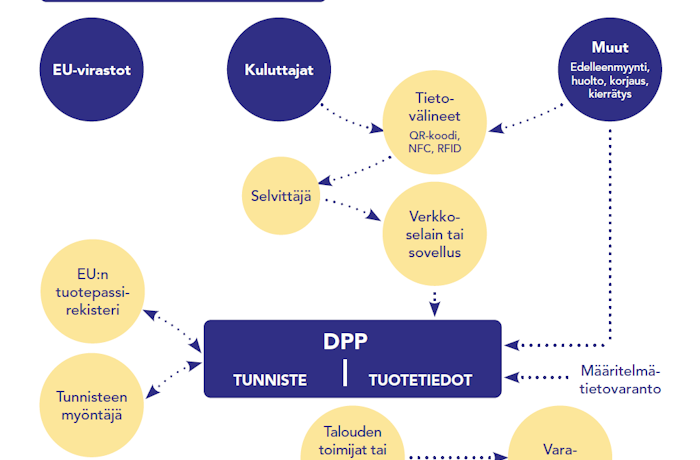
The digital product passport is readable from a unique identifier on the product. The identifier is usually a QR code or RFID tag. The records are stored in data reserves.
Who prepares the digital product passport?
The manufacturer or importer who places a product covered by the Ecodesign Regulation on the EU market is responsible for creating a digital product passport, registering it in the EU Product Passport Register and making it available in accordance with the legislation. The record must be available throughout the product's life cycle.
Often, the product information required by the DPP already exists, although perhaps scattered across different information systems. It is the operator's responsibility to make the product information available reliably and in accordance with the requirements. The product passport combines, organizes and publishes information from existing sources.
The operator can choose whether to organize the DPP service itself or delegate parts of the services to an external expert.
What is the timeline for creating digital product passports?
Product passport requirements will be introduced in stages through delegated regulations under the Ecodesign Regulation.
The Product Passport applies to most physical products, but not, for example, food, pharmaceuticals, and defense-related products.
For example, batteries must have mandatory battery passports from February 2027.
Delegated regulations on the DPP are also expected from the European Commission for iron and steel products during 2026, and for textiles, tires, aluminum and energy-related products in 2027.
Furniture is set to receive its own delegated regulation in 2028, according to the preliminary schedule. Information and communication technology products are set to receive a delegated regulation in 2029, as are mattresses. Paints and chemicals will receive a delegated regulation in 2030.
Once the delegated act has been published, operators have 18–36 months to bring their operations into compliance.
What should the company do now?
SFS emphasizes in its guide that operators should not wait for delegated regulations to enter into force.
The first step for organizations is to begin to identify how product information is currently managed and where the information is located.
Therefore, it is advisable for the company to:
- Map product information.
- Find out what systems they are in now.
- Identify missing information.
- Follow the delegated regulation for your own product group.
What are the benefits of a digital product passport?
The Digital Product Passport enables transparent exchange of information across value chains. The DPP can, for example, convey information that facilitates repair, reuse and recycling.
DPP promotes the development of business models that are in line with the circular economy.
DPPs support traceability, circular economy, ecological product design, and compliance.
The DPP also facilitates market surveillance.
Ecodesign Regulation (EU 2024/1781) provides a cross-cutting framework for sustainability, circular economy and product information requirements for products placed on the EU market.
How do standards support the DPP system?
Eight European standards form the technical basis of the digital product passport.
For companies, they provide common practices for implementing a product passport and help prepare for future requirements.
The standards cover the entire data management chain of the product passport: product identification (EN 18219), data carriers such as QR codes and RFID tags (EN 18220), and the structure of the data collected in the product passport (EN 18223). EN 18216 defines the data formats and data exchange protocols, and EN 18222 the interfaces through which data can be registered and retrieved.
In addition, the standards define data storage and retention (EN 18221), access rights, data security and protection of confidential information (EN 18239), and means to ensure the authenticity, integrity and reliability of data (EN 18246).
Together, the standards help a company build a product passport whose data is interoperable, securely accessible, and can be managed in accordance with future DPP requirements.
Standardization work related to the product passport continues globally in a joint technical committee of ISO (International Organization for Standardization) and IEC (International Electrotechnical Commission).
See more information about digital product passport standards.
Text: Elina Saarinen, Uusiouutiset
Image: SFS: Technical structure of the DPP system.
More on the topic






Uusiouutiset newsletter