
Flow Festival is underway in Suvilahti, Helsinki. In addition to music, visitors will be treated to a taste experience that is in line with sustainable development. The festival does not serve red meat or…
Flow Festival did an environmental budgeting: A local festival is an eco-friendly act, as long as you don't come by plane



The majority of the audience can arrive with low emissions, but a relatively small minority flying can still significantly increase the overall festival footprint. What can a festival organizer do to reduce environmental impact?
It will be held again in Suvilahti, Helsinki, on 14–16 August 2026. known for its responsibility music and urban culture festival Flow Festival.
In addition to music from around 150 artists, there will be a curated art program and topical speeches.
This year, Flow Festival has been designed using environmental budgeting.
The event organizer, in collaboration with the expert company D-mat, has produced a material and carbon footprint tool based on research, data analytics and monitoring, which is used for budgeting consumption and emissions.
The event will inevitably have environmental impacts.
Environmental budgeting examines the event's production, real estate, logistics, consumption, small purchases, food and beverage services, and visitor travel.
The goal is to reduce the event's material consumption, or material footprint, and also produce the smallest possible climate emissions, or carbon footprint.
“Although Flow has always strived to operate as responsibly as possible, staging an event like this inevitably leaves a mark on the climate and the environment. We strive to keep it as small as possible. Our Artistic Director Thomas Kallio has said that the lowest-emission event is the one that is never held,” Flow Festival CEO Katariina Uusitupa says.
According to Uusitupa, other event organizers have also been interested in Flow's environmental budgeting. The tools tested in Helsinki have also been tried out in Turku, for example.
Pilot increases footprint
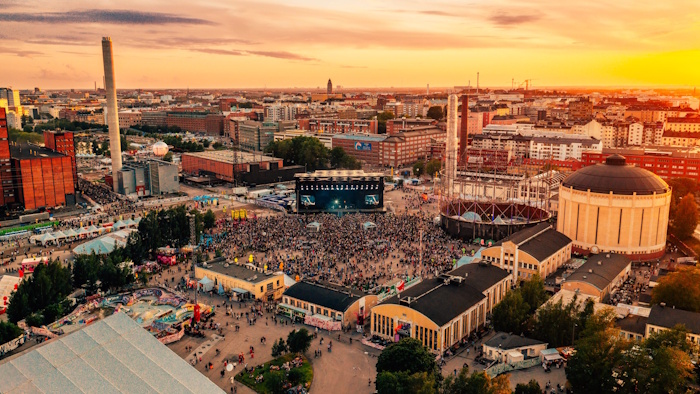
Flow typically brings together over 90,000 visitors to Suvilahti, Helsinki, during the three festival days.
Uusitupa estimates that an urban festival produced nearby is perhaps the most ecological way for city dwellers to see their favorite artists live. Ideally, the venue can be reached on foot, by bike or by public transport.
A material consumption and emissions study conducted with D-mat revealed a surprising fact: Although up to 80 percent of Flow's visitors arrive with low emissions, the event's overall footprint increases significantly if even a small portion of attendees arrive by plane.
International artists' flights to Helsinki also have a significant impact on the overall footprint of the event. Flow aims to collaborate with event organizers in neighboring countries to ensure that artists' flight routes are as low-emission as possible.
However, the event organizer's ability to influence the travel of the audience and performers is limited.
Last year, Flow Festival's consumption and emissions increased compared to 2024.
Emissions were increased, particularly by artists' increased air travel. The carbon footprint increased by a total of 336 tons from 2024 to 2025.
Uusitupa says that there are annual variations in consumption and emissions, for example depending on the artist coverage.
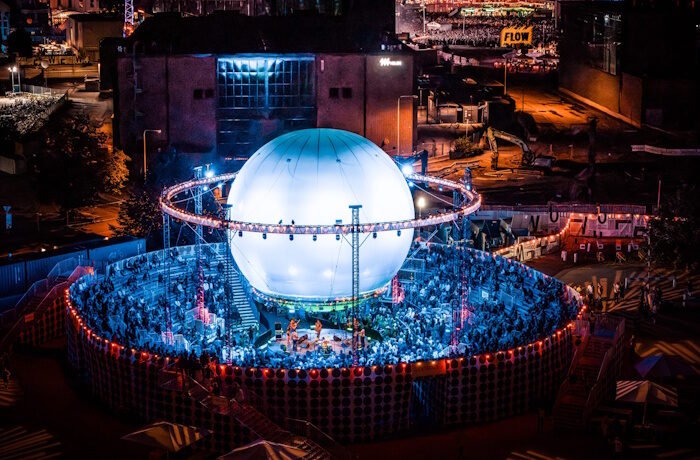
Material consumption was increased by new, multi-year structural purchases: Flow purchased a striking, reusable balloon for the Balloon venue and new Flow letters for the main gate.
The Hanasaari power plant area also needed soil preparation.
The organizer chose to serve vegan food
Flow's organizers have decided to focus measures to reduce emissions and material consumption especially on those aspects they can influence.
One of the most important ways is the food served at the event.
The festival's signature feature is its plant-based and sustainable food and beverage selection. This year, food will be served primarily from biodegradable containers and drinks from reusable hard plastic glasses.
Over 40 restaurants and cafes will be serving visitors during the festival weekend. As in previous years, no red meat or poultry will be served at the festival.
The festival staff's meals and backstage meals have been completely vegan for the past two years.
The art of demolition and recycling reduces waste
Uusitupa says that the festival has managed to reduce the amount of waste generated at the event by almost thirty percent. Although the number of visitors has increased, last year the total amount of waste was Flow's lowest in ten years.
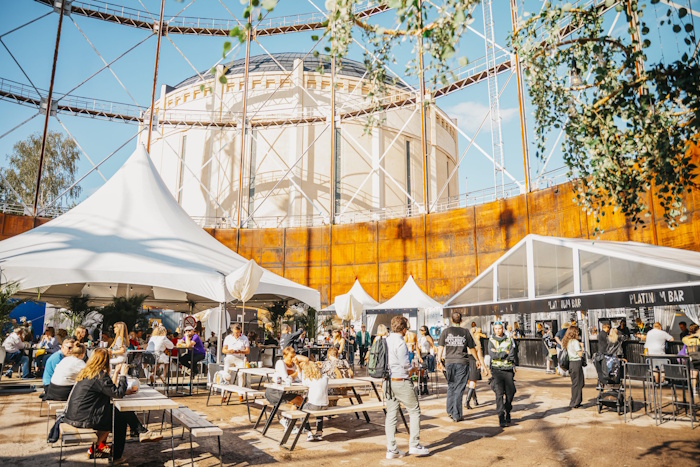
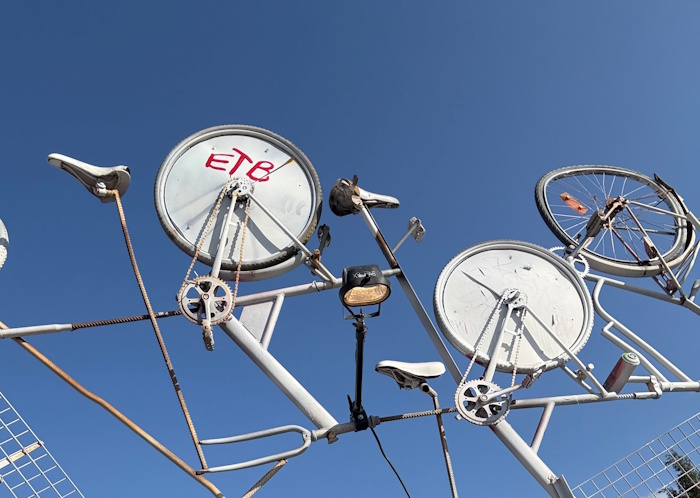
According to Uusitupa, the decline is explained by many factors. The event's structures and art in the area promote reuse and recycling. Flow collaborates with, for example, the Uusix workshop and the demolition art group.
Most of the platform structures and technology come from subcontractors. In-house structures, such as the balloon of the Balloon platform, are kept and reused. The top end structure of the end platform has been the same for several years.
"The more we can save and store, the less we need to buy new. If we are getting rid of something, we put the materials into circulation, for example through Roinaränni," Uusitupa explains.
Roinaränni is a recycling community for Finnish performance technology materials founded on Facebook.
Flow's waste management partner is Lassila & Tikanoja. It supplies pallets of recycled plywood for the construction of the area. Artists in the area have been able to utilize the company's waste materials in their works.
This year the artist Laura Lehtinen has built a familiar-looking seating group by the main gate. Its frame comes from the Amos Rex courtyard.
In addition, the festival wants to minimize unnecessary noise.
“Two years ago we stopped making Flow's own brand [merchandises, related products, ed. note]. For example, we don't make new t-shirts because the emissions from the fashion industry are huge,” Uusitupa says.
The event shop will sell forest gift cards from the Natural Heritage Foundation.
"Instead of a festival goer buying a t-shirt, they can protect a piece of forest," Uusitupa encourages.
Separate collection of energy waste ends
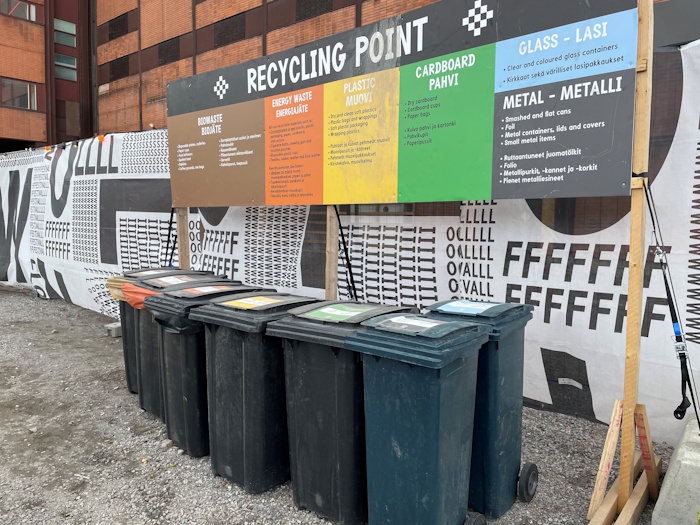
The food stalls are committed to sorting waste correctly. The event will separately collect cardboard, glass and energy waste, among other things.
Separate collection of energy waste will end after this year due to changes in legislation.
There has also been a change in the collection of biowaste. Previously, packaging could also be placed in the biowaste container, but in the future, only clean biowaste will be sorted there.
Because festival-goers are not always able to sort correctly in the midst of the festivities, event employees and volunteers still go through the biowaste containers before their contents are passed on.
Reusable drinking cups from bars
Drinking cups and mugs made of hard plastic reduce the amount of plastic waste.
Deposit-based, reusable cups have been used at Flow for years. They can be returned to official collection points. In addition, all thirty or so bars at the event will accept reusable cups.
Although the area has plenty of waste points and a good selection of trash cans for waste sorting, after the last artist of the evening the field is usually full of trash.
A relatively large amount of sweeping waste accumulates, approximately 14 percent of the total amount of waste.
"Flow's goal is to move towards a sustainable lifestyle. Achieving the footprint goals also depends on the behavior of visitors," Uusitupa knows.
A large festival can strive to be ecological, but the organizer cannot solve everything. Ultimately, part of the footprint is created by the choices of the audience.
Flow Festival key figures 2025
The Flow Festival held in 2025 produced a total of approximately 42,3 tons of waste.
Approximately 14 tonnes, or about 34 percent, of the waste was energy waste. The second largest amount was wood-based waste, approximately 7,6 tonnes, or 18 percent.
The share of biowaste was approximately 13 percent, and construction waste approximately 7 percent.
The festival's material and carbon footprint increased compared to 2024.
The total material footprint was 2,796 tons, or approximately 30,2 kilograms per daily visit.
The carbon footprint, calculated in tons of carbon dioxide equivalent, was 1,312 tons, or 14,3 kilograms per daily visit.
A day at Flow has a carbon footprint equivalent to driving about 80 kilometers in a gasoline car. That's slightly less than half of the average Finn's daily emissions.
The material footprint, in turn, corresponds to approximately a quarter of a Finn's daily material consumption.
The material and carbon footprint of partner productions decreased by approximately 17 percent from the previous year. Water consumption was reduced by a total of 60,000 liters compared to the previous year. Energy consumption in the area also decreased.
Flow Festival has reduced its environmental debt by donating money annually To the Natural Heritage Foundation starting in 2022. Donations so far have helped to protect, for example, the bird-rich Pukki forest in Joutsa.
Flow's partner this year is, among others, the used clothing app Tise.
The long-standing collaboration with the John Nurminen Foundation continues. Visitors can purchase a Baltic Sea ticket and make donations to the foundation.
Text: Elina Saarinen, Uusiouutiset-magazine
Photo: Petri Anttila & Koptercam/ Flow Festival. The huge balloon on the Balloon stage is Flow Festival's own stage structure, which is reused year after year.
More on the topic



Uusiouutiset newsletter