
Give something used as a gift this Christmas! According to a survey by Tori.fi, up to 95 percent of respondents would accept a used Christmas gift if it were…
Zero Waste Christmas Checklist: Give the Gift of Time Instead of Goods



Waste management companies have once again put together good tips for celebrating a sustainable Christmas.
For example Lounais-Suomen Jätehuolto (LSJH) reminds us that the most important advice during the Christmas season is to think about whether you really need to buy something new. Read LSJH's full list of tips below.
This is how you leave a smaller load for tomorrow:
- Don't produce unnecessary waste!
The world is full of intact stuff that people throw away as waste in the way of the new. Please don't do that.
Before you buy, consider whether you really need something new. Could you borrow the product you need instead of buying it? Consider whether it is absolutely necessary to replace a working product with a new one. Use up your items until they are finished and sort them when they become unusable. Only by sorting can materials be kept in circulation. If you do not know where to sort your items, ask your local waste management company for advice.
If an intact item feels useless and you no longer really need it…
- Donate to those in need, sell on!
Usable goods are not waste. Do not bring them to a sorting station or sort them in a waste container, but give them to someone in need. Undamaged furniture, dishes and lamps can be donated, for example, in social media groups or online flea markets. Donations of goods and clothing are accepted by several charities and recycling centers. Donations are often also accepted by parishes in your area, from whom you can inquire about donation needs.
You can also sell usable items at live or online flea markets or inquire about interest in purchasing your items from a nearby buy and sell store.
- Maintain, repair and mend your belongings!
You can prevent waste by taking care of your purchases. A good example is shoes and clothes, which can be cared for to extend their lifespan. Tips for caring for different types of shoes can be found, among other things: From Martto's pages. Näppärä mends worn-out wool socks and shirts and sews or mends holes in clothing.
Cities are full of craft professionals who can quickly maintain and repair clothes, shoes, and bags, and bring furniture that has seen its best days back to life.
Pirkanmaa Waste Management and Eco Partners have created Korjaa.se platform, which connects repair service providers and those who need them.
- Don't buy new, buy second hand!
If you need something new, first browse through social media and online flea markets, visit flea markets, and visit second-hand stores.
Clothing, vintage and home textiles can be purchased at a low price per kilo, for example at LSJH's textile recycling store. Favorite From Turku. The store has textiles brought in by residents for the end-of-life textile collection, which are still completely usable and which professional sorters have sorted out from the end-of-life textile going to material recycling. Remember to donate usable textiles to charity collections instead of collecting end-of-life textile!
- Buy durable and long-lasting products – but don't buy too many of them!
Don't fall for fads, and don't wrap your Christmas presents in unnecessary junk. Due to current consumption habits, humanity used up its renewable natural resources on August 1st this year.
When it comes to sustainable and long-lasting products, textiles are a good example, as over 40 percent of the textile industry's greenhouse gas emissions could be solved by simply using clothes for longer periods of time. The textile and fashion industry is the second most polluting industry in the world, producing more greenhouse gas emissions than aviation and shipping combined. By thoughtfully purchasing high-quality, long-lasting favorite clothes and using them again and again, you are giving the planet the Christmas gift it deserves.
- Give an intangible gift!
Give your time instead of gifts! Play with your children, read them a book, go sledding on the sledge hill. Create snow in your grandparents' or neighbor's yard. Order a house cleaning service for your parents, or help them with their Christmas preparations yourself. Invite a friend over for Christmas mulled wine.
Through charities, you can, for example, gift someone literacy skills, support work to mitigate climate change, purchase life-saving medical care for crisis areas, buy porridge for an entire village, help a lonely friend, help victims of a disaster, or bring Christmas joy to a child at risk of exclusion.
- Only buy as much food as you can eat!
The website "Saa Eödä!" According to the World Health Organization, around 30 percent of all food produced ends up as waste, and in Finland, as much as 10–15 percent of all edible food is wasted throughout the entire food chain, or around 360 million kilograms. This means around 8 full truckloads of food waste!
If you waste food during Christmas, use the leftovers in pizza, pies, and soups between Christmas and New Year's. Recipes have been compiled by, for example, Martat.
For more tips on reducing food waste, see: From the "You Can Eat" website.
- Save energy and participate in its production – sort your biowaste!
By sorting biowaste, you contribute to supporting the local circular economy and increasing domestic energy production, meaning you support Finland's security of supply!
You can save energy in everyday life in many ways. You can find energy saving tips, for example: From the Consumers' Association website.
9. Make use of what exists!
Wrap an item you don't need or something you know someone else will appreciate in a package.
Text: LSJH.
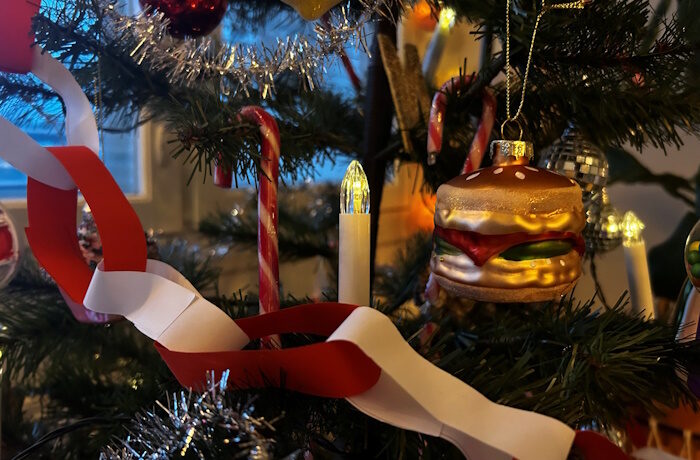
Photo: LSJH. Plastic and glass Christmas decorations should be disposed of in the mixed waste bin when broken. Christmas light sets, on the other hand, are electrical and electronic waste, meaning they should be taken to the WEEE collection point.
More on the topic




Uusiouutiset newsletter