Family-owned recycling group Kuusakoski Oy has acquired the entire share capital of Tramel Oy. Tramel, a recycling industry company founded in 2008, specializes in electrical and…
How to recycle a broken Christmas toy?




This one Christmas hit toys are interactive and contain electronics.
This means that when toys reach the end of their useful life, they cannot be put in the mixed waste bin. They are electrical and electronic waste, or WEEE, and belong to the WEEE recycling point.
"If electricity has passed through a toy, it is always SER. If it has a battery, a plug or a small solar cell, it belongs at a SER recycling point," summarizes Elker Oy's operational assistant. Blue Ice.
This applies to crying dolls, talking stuffed animals, and even remote-controlled cars.
Jääskeläinen reminds us that even battery-powered locomotives on the railway line are SER when they are retired.
So what should you do with a broken, irreparable SER toy? And how well can such items be recycled?

Identify by the sign
Scrap that is not suitable for mixed waste can usually be identified by the fact that the device, packaging or user manual has a separate collection symbol for SE waste: a trash can with a cross over it.
SER devices must be sorted and returned to a SER recycling point.
There are SER recycling points at waste companies and at over two thousand distribution points, i.e. stores and shopping centers. They are marked with SER symbols and instructions.
Small toys and small electronics under 25 centimeters can be returned to store points.
Broken Christmas lights, electric candle holders and light sets can also be returned to the same points.
There are separate return points for loose batteries and accumulators.
Recycling points can be found online: SER-kierrätys.fi or kierratys.info.
A dedicated point for batteries
When returning a former toy to a SER recycling point, there is no need to remove or disassemble the batteries, but the toy can be returned intact.
If you have already removed the batteries, it is important to return them to separate collection points for batteries and accumulators. The terminals should be taped.
Loose batteries pose a fire risk at the SER recycling point.
Jääskeläinen hopes that people will consider what they give as gifts and avoid cheap, disposable electronics that break easily and can cause safety risks during both use and recycling.
For domestic processing plants
If you have no time for that crying, stuffed doll that was revealed in a Christmas package, it's worth taking it to a SER recycling center.
Old toys that are properly sorted for SER recycling end up at domestic recycling facilities, for example Kuusakoski.
“We process Finnish SER safely, appropriately and with environmental considerations in mind,” says Kuusakoski’s Customer Experience Manager Tatu Karlström.
Domestic partners approved by producer organizations for the processing of SER include, in addition to Kuusakoski, Stena Recycling, Tramel, Elwira, Suomen Materialikäisteili, Vammalan Hyötykeräys and Iisalmen Teräs ja Metalli.
In addition, SER is received and processed at several third sector or municipally run activity centers, workshops, recycling centers, and foundations.
However, not all of these deal with WEEE toys. Some operators specialize in handling a specific type of WEEE, such as end-of-life electrical and electronic equipment from companies.

Hammer for work
First, the batteries are removed from the toy by hand. This requires a lot of work and expertise.
For example, the Kuusakoski processing plant line employs two to eight employees, depending on the production situation.
"When a SER load arrives at our collection point, we first do a rough sorting by hand. Employees remove certain types of equipment and irrelevant items from the conveyor so that nothing flammable or flammable ends up in the process," Tatu Karlström explains the initial stages of the toy scrap recycling process in Kuusakoski.
Devices containing batteries are also separated at this stage.
“It takes practice and expertise to learn to see which device may have a battery inside,” Karlström points out.
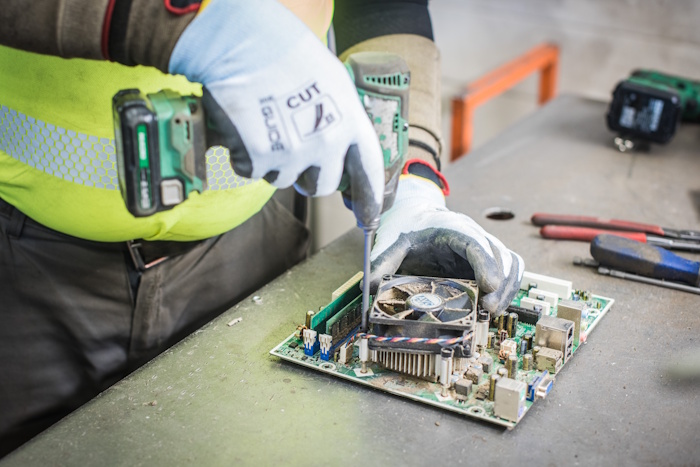
Recyclers have a variety of basic tools at their disposal, from screwdrivers to hammers. They use them to break the toy as little as possible, but enough to remove the battery inside. Care must be taken to ensure that the battery is not damaged in the process.
In many toys, the battery is hidden in a case closed with screws or otherwise inside the toy so that small parts cannot get into the mouths of players.
In addition to toys, small SERs also include other devices such as Bluetooth speakers and electric toothbrushes, from which the battery is difficult to remove without breaking the casing of the device itself. The battery can be dug out by first twisting the plastic device open.
“This is a laborious manual process, but it just has to be done,” Karlström summarizes.
A recycling worker removes the battery from the doll as efficiently as possible. It is placed in its own container.
Toy to shred
After that, the toy goes to the shredder along with the rest of the SER.
After being crushed, the doll is no longer recognizable. It has disintegrated into fragments, revealing the various materials used to make it.
Different materials can be separated using a recycling line. For example, metal pieces and plastic pieces can be separated from each other.
If the doll contains metals, such as springs or wire, they can probably be recycled.
Metals are a good material for recyclers because they have value in the secondary market. The metal is sold as a raw material to the metal industry, which uses the metals in the manufacture of new metal products.
Plastics are a difficult piece
The doll's textiles and padding, such as lightweight foam plastics, are separated into their own fraction and directed to energy use.
Plastics, on the other hand, are a more difficult item for recyclers.
It is technically possible to recycle plastic waste, but it can be difficult to find an economically viable recycling use for toy plastic.
Electronic toys in particular can contain many types of technical plastics, which are very difficult to separate into high-quality and clean recycled plastic.
For recycled plastic to be suitable for new products, its quality, color, durability, and other properties would have to be suitable for the new application.
To achieve this, a long and expensive processing chain is required.
“In the recycling chain of lightweight materials, logistics costs per ton of raw material are highlighted. The recycled plastic market is challenging. It is still difficult to compete with virgin plastic, at least from a price perspective,” says the business director. Tapio Kuusakoski.
Harmful substances out of circulation
In addition, toys in particular must meet strict fire safety regulations. This means that the plastic of the doll may contain harmful substances, such as flame retardants.
“Harmful substances must be removed from the material cycle,” Research and Development Manager Tiina Malin highlight.
In Kuusakoski, plastics containing harmful substances are identified, separated and directed to energy recovery.
Malin says that research is underway around the world to try to find new uses for flame-retardant plastics, for example so that plastic containing flame retardants can find its way back into recycling applications that require flame protection.
“This is not an easy task, as some of the old fire retardants are now banned,” Malin points out.
From an economic point of view, recycling toy electronics is not particularly attractive to recyclers, because they contain few valuable materials such as metals.
“The value of recycling toys and other plastic-containing objects consists of other factors, such as proper handling and responsible operations,” Tapio Kuusakoski emphasizes.
Photo: Elävät Kaupunkikeskustat ry. Will the goat bring electronics this year? When it breaks down, take it to the SER recycling.
Photo: Scanstockphoto. A crying doll usually contains a battery. This means that when it breaks down, the doll is electrical and electronic waste. Recycling it is a challenging process.
More on the topic


Uusiouutiset newsletter