

More clothing reuse, less textile waste. This is the goal of the new EU-funded Baltic2Hand project. It uses service design to develop innovations and new business models for the textile industry, as well as…
Consumer survey: Consumers would switch to the circular economy for peace of mind




Consumers will not buy circular economy products or services for ideological reasons, but because they are more attractive, easier and more useful to them than those produced using the traditional linear economy model.
It would not be worth moralizing consumers who buy ultra-fast fashion from Shein or cheap stuff from Temu, because this particular customer group could easily switch to circular economy products if circular economy compliance would clearly benefit them.
Circular economy brands should build solutions that are so attractive and carefree that they have appeal to the masses.
This is how you could sum it up Alice Labs the results of a recently published study on consumer behavior change.
CEGO project to support businesses
Consulting company Alice Labs interviewed Finnish consumers and investigated consumers' relationship with goods, consumption, and the circular economy.
The research was commissioned by the Region of Uusimaa and led by Laurea University of Applied Sciences, and was funded by the EU. Circular Economy Go project CEGO.
The CEGO project supports companies in Uusimaa in circular economy business.
“The customer and market understanding provided by the research helps companies innovate new circular economy solutions and plan marketing,” says Laurea lecturer and leader of the Circular Economy Go project. Kati Tawast.
Circular economy hype alienates
According to the study, Finns have a practical approach to consumption.
Circular economy solutions such as recycling, repair and buying used are good starting points because they can offer cost savings and help keep products in use for a long time.
“Things that are practical for the consumer and that create value for themselves in everyday life guide decision-making. For example, people buy used goods if they can get them cheaply and if they are of good quality,” says Alice Labs’s Oskar Korkman.
He spoke at a webinar organized by CEGO on February 11th.
However, the study also found obstacles to consumers moving more broadly towards a circular economy.
"If circular economy and responsibility are discussed as an ideological, production-technical issue, this can even alienate consumers. They start to experience it as a burdensome obligation that requires them to change their behavior," says Korkman.
Carefree life without a crank
Only a small group of pioneers sees the circular economy as an attractive entity, in which product longevity, repairability, modifiability, and resale value are key.
"For some, the circular economy may even give them an excuse to buy fast fashion, because it can then be easily resold second-hand. Consumption lacks the long-term perspective that would lead to a truly multi-cycle market," Sebastian Schauman Alice Labs points out.
According to the research results, Finnish brands should make the circular economy attractive to the masses so that it produces pragmatic benefits for the consumer. It is therefore worth emphasizing the circular economy as an everyday and sensible thing.
The easiest commercially interesting and successful concepts would be to build on buying used goods, extending the useful life of goods, and improving the quality of goods.
"We believe that quality criteria are undergoing a historic change. The attractiveness of the circular economy could be increased by innovating the concept of quality. Quality can mean repairability, longevity, usability, maintenance options and resale value," Korkman emphasizes.
Quality can also be associated with peace of mind, as replacing an old product with a new one is often perceived as a hassle. In that case, the longevity of the product is a clear advantage.
"Carelessness can mean that someone buys a lot of things from Temus for a cheap price. But carelessness also means owning a few things and using them for a long time," Korkman reminds.
Circular economy accelerator
The CEGO project is a two-year project funded by the Region of Uusimaa that supports companies in circular economy business.
The CEGO network already includes over 30 companies, organizations and brands such as Lumene, Inrego and Fiskars.
Companies receive support for their circular economy transition from Laurea's development About the CELLL tool, which helps develop circular economy product and service concepts.
Companies also have the opportunity to deepen their expertise in circular economy accelerators organized in March-April.
Sparring and support
Companies in the CEGO network can exchange experiences and ideas about circular economy business through company visits and presentations by circular economy pioneers. The network also opens up new opportunities for business collaboration.
"We are really happy that there are so many active companies in the network. It feels like there has been a demand for this. In the network, companies can spar with each other. The project has already made the participants come up with forms of cooperation," Tawast smiles.
Laurea's Business Partnerships Expert Minna Nurmisalo says that the strength of the network is the diversity of companies and the fact that we can study the circular economy together from many different perspectives:
“The network has brought together very different types of companies, from the IT sector to the furniture industry, and from startups to large companies.”
In December, the CEGO team visited the Nihtisilta store of the Helsinki Metropolitan Area Recycling Centre.
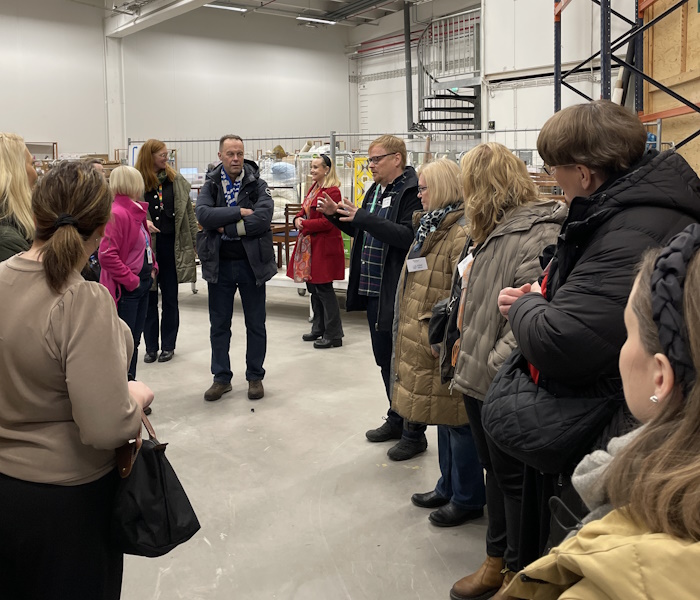
Ulla Reiman ja Henrik Lehela Freudenberg Home and Cleaning Solutions participated in the CEGO meeting in December.
The company manufactures, for example, Vileda Professional products. It is interested in the circular economy at the beginning of production, such as the use of recycled fibers.
"A lot has been done in Finland in the circular economy of textiles. The CEGO network cooperation is a continuation of this work. A circular economy cannot be implemented alone," Reiman and Lehelä say.
Text: Elina Saarinen/ Uusiouutiset-magazine
Image: Adobe Stock. Temuttaja might be interested in transitioning to a circular economy if circular economy solutions offered peace of mind.
More on the topic




Uusiouutiset newsletter