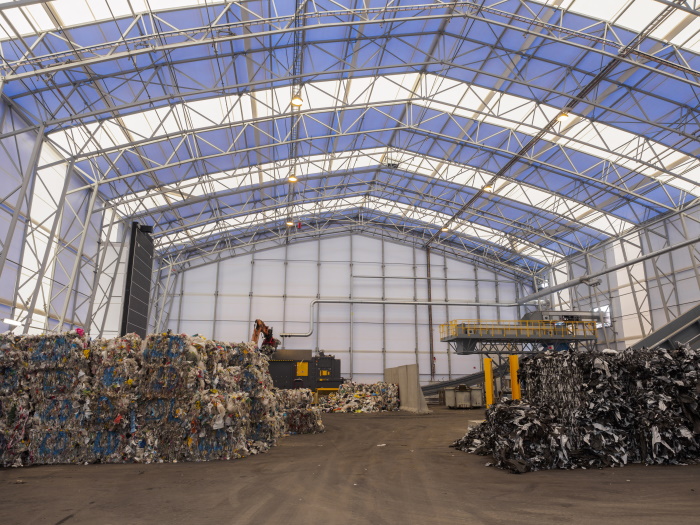
Fortum plans to double its plastic waste recycling capacity. Fortum plans to replace its plastic refinery in Riihimäki, which has been operating since 2016, with a new, more modern plastic recycling plant. The new plant will have a processing capacity of…
"Everything is taken to the same place" - The sorting myth is shattered




Where does sorted waste end up?
A study conducted as part of the WasteLess Karelias project examined where separately collected, recyclable waste ends up from the village's common waste shed.
As an example, household waste from the Diamond Villages in the Juua municipality in North Karelia was studied.
The waste routes in diamond villages are just one example. Waste ends up in slightly different places depending on where in Finland it is collected.
It was found that waste from Juua goes to dozens of domestic recycling and processing plants around the country. In addition, some of the waste is exported outside Finland to Sweden, Estonia or Germany for processing.
Long transport distances cause some emissions, but the environmental benefits of recycling waste are greater. That is why sorting and separate collection are worthwhile, says a researcher from the Finnish Environment Institute who conducted the study. Anne Holma:
“Waste ends up being reused when it is sorted – even in small villages and villages located further away from large centers, such as Juua’s Diamond Villages. Waste provides valuable raw materials, and recycling has many positive environmental impacts. Although transportation distances can be long and cause carbon dioxide emissions, utilizing waste as raw materials for new products is more environmentally beneficial than manufacturing using natural resources and other primary raw materials.”
New plastics plant in Riihimäki
Plastic packaging collected and sorted separately by residents of Juuka and other Finnish households travels to Riihimäki. There, the plastic is recycled by Fortum (formerly Ekokem) in 2016. at a plastic refinery.
Plastic packaging waste is processed into, for example, recycled plastic granules, which the plastics industry can use in the manufacture of new plastic products.
Finns have become so enthusiastic about sorting plastic packaging in recent years that the Riihimäki plastic refinery has not capacity is no longer enoughTherefore, Finnish plastic packaging waste has also had to be temporarily exported to Sweden and Germany for recycling.
Soon, plastic will be recycled mainly domestically again. In July 2021, Fortum announced that it would replace the small Riihimäki with a new plastic refinery, with a modern and larger capacity plastic recycling plant.
Recycling plastic saves energy and oil. According to the Finnish Recycled Plastics Association, a kilo of recycled plastic reduces 1,5 kilos of carbon dioxide emissions compared to virgin plastic.
The nationwide plastic recycling rate for non-deposit plastic packaging in 2020 was 19,87 percent. The goal is to increase the recycling rate to 50 percent in the coming years.
One way to increase the recycling rate is for households to sort plastic packaging waste. Still, the amount of plastic waste that would fill 14 houses of parliament was put into mixed waste.
Metal heads north
Metal packaging and small metal are delivered from Juua and other parts of Finland to Tornio. There the metal is crushed. It can then be melted down into raw material for the steel industry.
For example, recycled metal plays a significant role in Outokumpu's steel production. The Tornio plant recycles over a million tons of metal waste annually. Use of recycled metals in Tornio helps the factory reduce its greenhouse gas emissions.
Using recycled metal as a raw material reduces the energy requirement for manufacturing a new product by 60–95 percent.
The quality of the metal is maintained in recycling processes from one use cycle to the next, so after one life cycle, the metal can be recycled into new steel production processes practically indefinitely.
Domestic glass cleaner
Deposit-free glass bottles and jars sorted by Finns have previously been processed for recycling in the Netherlands and England, but last year the situation changed, favoring domestic recycling.
Finnish Packaging Recycling RINKI Oy signed an agreement in 2020, according to which the majority of glass packaging is processed into recyclable form at the Uusioaines Oy factory in Forssa. The same facility also handles the processing of glass materials from Finnish Return Packaging PALPA.
The recycled material cleans the packaging glass pulp collected by Ringi. The majority of it is delivered to the packaging glass industry as chip-like recycled raw material.
The entire circular economy cycle cannot be implemented domestically, because Finland does not have an industry that manufactures glass packaging.
Some of the collected glass is not suitable for the production of packaging glass. From it, Uusioaines produces Foamit foam glass, which can be used as a raw material for infrastructure and building construction.
Another of Ringi's contractual partners is the Estonian Krynicki Glass Recycling Oü. It cleans and sorts glass in Järvakandi.
The study traced the journey of glass packaging from Juua's Diamond Village. The results of the study confirm that glass packaging waste does indeed travel in the manner described above: From Juua, glass packaging first travels to the Kuopio terminal. From there, it is transported to glass processing plants in Forssa and Estonia. There, the glass is processed and delivered as raw material to glass packaging factories.
According to a study commissioned by Ringi, sorting glass packaging reduces greenhouse gas emissions by 11 tons.
In Finland, a total of over 2020 million kilograms of deposit-free glass packaging was recycled in 25,5, or 4,6 kilograms per inhabitant.
(See the map image below as a pdf.) 
Collected fibers still circulate mainly domestically.
The cardboard sorted by the people of Juuka travels to an intermediate warehouse to be baled. When the load is full, the bales are transported to cardboard factories as raw material. They are located in Varkaus and Pori. A small part, about 5 percent of the collected cardboard, is also exported to Sweden.
Recycled cardboard is used to make corrugated cardboard, packaging cardboard and paper, laminate paper and cores.
Recycled paper is exported from Juua to many places. Via Joensuu, it ends up in Kuusankoski, Kouvola, at the production unit of Encore Ympäristöpalvelut Oy. There, the material is baled and transported for use by Finnish paper industry companies such as UPM and Stora Enso, although to foreign newsprint mills.
In addition, recovered paper is exported to the Metsä-Tissue factory in Mänttää, where it is used to make tissue paper.
It is also taken to Nokia. That's where the recycled paper goes. To the Nokia tissue paper millThe factory is part of the international healthcare product manufacturer Essity, which uses a total of one million tons of recycled paper per year in its 150 operating countries.
When UPM decided to close its Kaipola mill in Jämsä in 2020, a large domestic waste paper recycler also left. For new, domestic waste paper recyclers I would like to order now..
Recycling paper saves natural resources, i.e. forests. Why cut down trees for toilet paper when equivalent toilet paper can be made from recycled paper?
Electrical waste for SER collection
All devices that are no longer in use and operate on electricity, batteries, or solar energy are subject to WEEE recycling. They are taken to producer organizations' collection points or sorting stations. Stores also accept WEEE (electrical and electronic waste).
Small household appliances from Juua are transported to Rantasalmi. Large household appliances such as washing machines, dryers, dishwashers and ovens are transported to Kajaani.
The used refrigeration equipment, in turn, goes to Revac Sverige in Sweden.
In the plants, SER is pre-treated and harmful substances such as CFC and HCF are removed from it. Metals are recovered, for example, by crushing and separating metals with magnets, as well as by melting or dissolving.
Recycling SER saves valuable, non-renewable natural resources. Up to 99 percent of the materials in certain devices can be reused as industrial raw materials.
However, there are major global problems in recycling chains, and not all of the materials contained in devices are recycled. valuables and rare materials currently be recovered and sent to official recycling systems.
There is also room for improvement in recycling processes. Devices are not designed to be disassembled and recycled. For example, in smartphones, dozens and dozens of elements are compressed into a dense body, and a single material such as gold may be an atom-thick layer or a few grams.
One of the world's largest airports is planned for Finland from the first institutions, which recovers precious metals and rare earths from IT equipment scrap.
In addition to developing recycling processes, it is important to change the value chains and design of electronics and electrical devices in a way that extends the lifespan, repairability, upgradeability and recyclability of devices.
The EU is planning for this sustainable products initiative and an initiative to strengthen the role of consumers in the green transition. Consumers will be able to make sustainable device and product choices easier with digital product passports. Initiatives are expected from the EU in spring 2022.
Biowaste for home composting
It is advisable to process biowaste close to where it is generated, because biowaste is heavy and the costs of transporting it can be high.
In the village studied, residents often compost their biowaste themselves, thus obtaining soil for their own use.
Although biowaste is collected separately in Finland more carefully than before, there is still room for improvement in sorting. Throughout Finland, recyclable biowaste equivalent to the weight of 20 large passenger car ferries is mixed with mixed waste.
If biowaste were sorted separately from mixed waste in homes, it could be composted, digested or processed into fuel at treatment plants.
For example biogas plants could produce biogas and recycled nutrients from biowaste, electricity and heat, and compost for nearby fields.
Recycled nutrients could replace inorganic fertilizers, the production of which generates a lot of greenhouse gas emissions. At the same time, it would provide renewable energy and combat global warming.
Tips for starting to sort biowaste can be found here. from biojäte.info.
The market dictates
The market influences where it is best to process different waste fractions.
If waste is generated in small quantities and has value, it is cost-effective to transport the waste centrally and over longer distances.
Hazardous waste requires a special treatment facility, which is why it is handled in a very centralized manner. From Juua, hazardous waste is taken to Fortum Waste Solutions' special facility in Riihimäki.
Sorting ensures that recycling is found
Finland is not excluded from the global trade in waste and secondary raw materials.
For example, the market for recycled cardboard, paper and other recycled fibers has been in turmoil in recent years. A few years ago, China imposed strict restrictions on the type of waste that can be imported into China. This has created pressure to build more recycling plants in Europe and the United States.
Right now, new recycling and processing plants for recovered paper, cardboard and paperboard are being built at a rapid pace in Europe.
However, there is not necessarily a demand for poor-quality collected fiber, and it may end up being used for energy recovery.
On the other hand, domestic waste fiber is of good quality, thanks to a good separate collection system and careful sorting by Finns.
Holma emphasizes that waste sorting by Finns is very important for the next stages of the recycling chain.
In the Diamond Village selected for the study, the village association maintains a waste collection point so that residents can sort nearby, in addition to energy waste, packaging waste such as metal packaging, small metals, glass, cardboard, paper and plastic. The costs of the recycling point are covered by money collected by the village association through donations.
"In rural areas like Juua, residents' own activity in sorting waste is particularly important. They often have to arrange waste management themselves or take separately collected waste to a waste center or collection point, even over long distances. On the other hand, in rural areas, home composting is widely used in the processing of biowaste," says Holma.
Routes vary
According to Holma, it was surprisingly difficult to track the movements of waste fractions, as there are many operators and there is little information available online.
"This is very understandable, as due to competition, the operators and thus also the routes and destinations of recyclable waste are changing. However, producer communities, waste companies and other parties kindly helped us compile the necessary information," Holma says with gratitude.
The study began last year. The information was updated several times during the project, as the routes changed.
The study is part of the WasteLess Karelias project, which aims to improve waste sorting and waste management on both sides of the border, in North Karelia and in rural villages in Russian Karelia.
It is interesting to note that although some waste is sent from Finland to other countries for processing, the study did not show any individual waste shipments from Finland to Russia for processing, nor from Russia to Finland. No, even though the village studied is located quite close to the Russian border.
Charity and art
The WasteLess Karelias project builds waste collection points in rural villages. Workshops and clean-up activities also encourage residents to sort waste.
Schoolchildren get active in a cross-border competition between schools. Art is also harnessed for a good cause: The project is implementing a Trash Art festival on the topic of waste.
The project, funded by the European Union, Finland and Russia, is led by the University of Eastern Finland. The project involves the Rural Education Association (MSL), the Institute of Economics of the Karelian Research Center (IoE) and the Finnish Environment Institute SYKE.
What message would the researcher of the study want to leave in the minds of Finns?
"The most important message is that recycling is worthwhile and separately collected materials are a valuable raw material. Utilizing recycled materials saves energy and natural resources," Holma emphasizes.
Read more about the report: https://www.slideshare.net/SYKEinfo/minne-kierrtyskelpoinen-jte-ptyy-suomessa-esimerkkin-juuan-timanttikylt-vuonna-2021
https://kareliacbc.fi/fi/projects/wasteless-karelias
Text: Elina Saarinen.
Patterns: WasteLess Karelias project.
More on the topic


Uusiouutiset newsletter