
(For subscribers). “Let’s put the good stuff in circulation!” This is what Miira Ojanen, Sales Manager at Southwest Finland Waste Management (LSJH), commented after receiving the I love me… Fashion Circular Economy Award, which was awarded to LSJH.
Fashion Circular Economy Awards for Untuvia, Linda Kokkonen and Sealevä at the I love me fair



A plastic replacement for outdoor products, eyeglasses and buttons from seaweed. Old lace for a sustainable wardrobe. Down has a life cycle of at least 150 years.
Such circular economy business ideas were put on a pedestal when I love me fair ja Breeding Association awarded the winners of the 2025 Fashion Circular Economy Competition with 2500 euros in three categories.
A new start-up was born from a seaweed side stream
A biomaterials start-up that utilizes side streams from seaweed production was chosen as the Inspirator of the Year Seaweed, which stems from a student project at Aalto University combining chemistry, art and design. In it, students were asked to come up with ideas for ways to utilize seaweed-based sidestream biomass.
The Sealevä team came up with the idea of producing a solid and durable material from the side stream, which is well suited as a bio-based and recyclable replacement for certain types of hard plastic materials.
The first product applications were small parts for the fashion industry, such as buttons. However, the material is suitable for many uses.
“I have worked in women’s fashion for seven years and have seen that there are serious sustainability issues in the fashion industry. I wondered how I could use my background and skills to create innovative alternatives,” founder and CEO Xuefei Shi The company is scheduled to be registered by the end of the year.
Fei credits Aalto University as a good springboard for a circular economy start-up. Sealevä can utilize Aalto's laboratory and scientific expertise in the development of pilot batches.
Information from life cycle analysis to sustainability reporting
Sealevä plans to implement two pilot projects next year and is currently looking for pilot partners.
Fei sees that applications could be found not only in fashion but also in accessories and outdoor brands, for which responsibility is important.
A team of six is designing a business model, one half of which consists of sidestream-based biomaterial applications, the other half is built on data that helps customer partners achieve their sustainability goals.
“For example, we have a data analytics expert on our team. We want to provide brand owners with accurate, traceable and verified lifecycle analysis data that they can use, for example, in sustainability reporting and future digital product passports,” says Fei.
A shift towards irresponsible contemporary fashion
The award in the designer or design category was received this year Linda Kokkonen.
She also has a background at Aalto University, where she completed both a bachelor's and master's degree in fashion.
The unsustainable practices of modern fashion inspired the fashion designer to seek a solution in the circular economy.
"At the beginning of my studies, I felt bad that the fashion industry was such a consuming and raw world. I started looking for a way to operate effectively in the industry, reducing pollution. I came to the conclusion that I didn't need to do anything new for my design work," Kokkonen explains.
From old to new
All the material Kokkonen uses already exists.
She looks for materials at flea markets, for example, dismantles old second-hand clothes and makes use of surplus. Silk and lace in particular, as well as a timeless design language, are characteristic of Kokkonen's designs.
In their justification, the jury highlighted that for Kokkonen, the circular economy and available second-hand materials are the starting point for the entire design.
“The circular economy is not an obstacle to creativity, but an enabler,” summed up the members of the expert panel, Emilia Gadd From the Finnish Textile & Fashion Association, Professor Emerita of Fashion Pirjo Hirvonen and a responsibility expert Tarja-Kaarina Laamanen.
A “capsule wardrobe” reduces the need to shop
Kokkonen founded under his own name corporate two years ago. He already has an established clientele, for whom he designs, for example, formal dresses or other custom work. One of the retailers exports products to the Japanese market.
He designed the costumes for, for example, Rodeo, which performed at last year's Castle Festival. Anna for Puu, Iida for Paul ja To Erin.
In addition to using recycled raw materials, Kokkonen's company also applies circular economy business models to its rental service. One new collection will be available for rental per year.
Kokkonen strives to minimize the amount of clothing customers need and maximize usage by designing collections of trusted clothing items.
The idea is that the user only needs a few favorite clothes, because they all go together and can be combined in an unlimited way. These so-called capsule wardrobe collections are sold by Kokkonen in pop-up stores.
Value for down
Helsinki-based company Untuvia has invented a way to recycle a valuable natural material that has so far been thrown into mixed waste: down and feathers.
Up until now, recycling down has been difficult because the material is prone to grease.
Untuvia, in collaboration with VTT, developed a solution for removing fat from down. There is a process in which valuable fats are extracted from worthless materials using supercritical carbon dioxide.
“We turned the process around: we extract the worthless fat from the valuable material,” describes one of Untuvia’s founders, Heikki Karkkäinen.
An invention from a Lapland campfire
The business idea came about a year ago while skiing in Lapland. A hole burned in his down jacket over a campfire. When he got home, Kärkkäinen tried to recycle the jacket, but it was surprisingly difficult.
A man with a background in marketing and entrepreneurship realized that the solution could hold the keys to a world-class invention.
Untuvia attracted venture capitalists and Finnish pioneers in the circular economy in the textile industry. Now the company is aiming for global markets, whose potential can be calculated in billions.
The award jury recognized the brilliance of the idea and awarded Untuvia in the Lifecycle Extender category.
“When used correctly, down has the potential to last up to 150 years. Untuvia combines technology and service design and offers solutions for recycling used down and extending its life cycle,” the jury praises.
Exceptional material
Kärkkäinen appreciates the award:
“It confirms that we can make this a truly responsible and profitable business.”
The company was founded from a market perspective. According to Kärkkäinen, textile recycling often fails to create a profitable business because the recycled materials are already quite low-value in the first place. It is difficult for their value to cover the costs of collection logistics and recycling processes so that they can compete with virgin materials.
"Down is an exceptionally valuable material. We realized that if we could solve the key problem, which is removing the fat, we could reduce production costs below the price of virgin down," Kärkkäinen explains.
Flying with down
According to Kärkkäinen, Finnish responsibility and circular economy expertise has been an exceptional platform for such a circular economy business model to take off.
Untuvia already has seven pilot customers, including domestic companies Halti and Joutsen.
The company is targeting global markets. In Europe, the impetus is provided by the textile producer responsibility that will come into effect in the coming years, which guides brand owners to extend the life cycle of their products through circular economy solutions.
The I love me fair and Jalotus ry presented the awards for the fashion circular economy competition for the fourth time. The competition aims to promote sustainability in the fashion industry by highlighting actors who are innovatively utilizing the circular economy.
Text: Elina Saarinen, Uusiouutiset
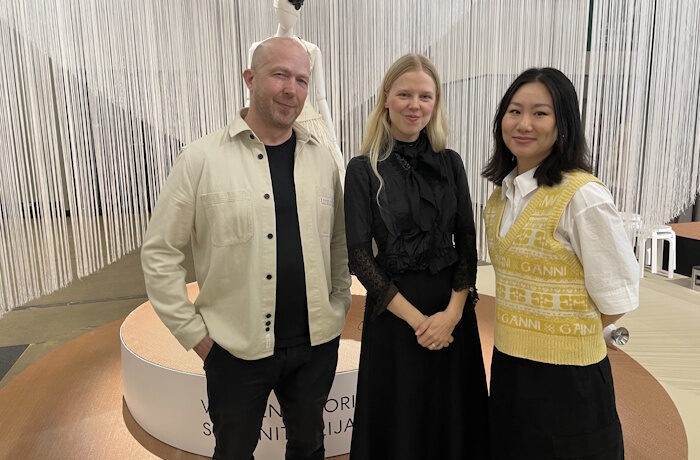
Photo: Elina Saarinen. Untuvia's Heikki Kärkkäinen, designer Linda Kokkonen and Sealeva's Xuefei Shi received the awards for the circular economy fashion competition at the I love me fair 2025.
More on the topic



Uusiouutiset newsletter