
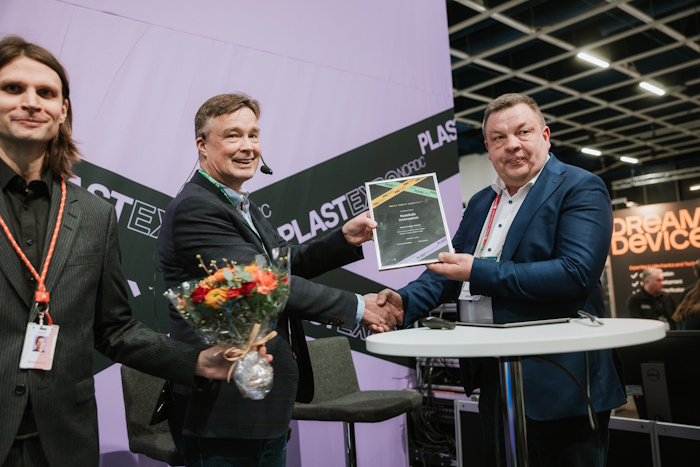
(For subscribers). “Let’s put the good stuff in circulation!” This is what Miira Ojanen, Sales Manager at Southwest Finland Waste Management (LSJH), commented after receiving the I love me… Fashion Circular Economy Award, which was awarded to LSJH.
Noora Yau, a doctoral researcher who developed wood-based crystals, was awarded 10,000 euros – Ecological sparkle replaces glitter



Doctoral researcher developing glittering wood for the fashion industry Noora Yau has been awarded a doctoral dissertation prize worth 10,000 euros by the Finnish Natural Resources Research Foundation.
Designer Noora Yau, who completed her PhD at Aalto University, wanted to find out whether sparkling color could be created without pigments, metals or plastics.
In his research, he focused on developing structural color (CNC SC) from wood-based nanocellulose.
Yau's dissertation Shimmering Wood – Experimenting with Nanocellulose-Based Structural Colour reviewed in February 2025 at Aalto School of Arts, Design and Architecture
Yau's research partner was a materials scientist Konrad KlockarsThe couple's work was supervised by, among others, a professor at the Department of Bioproducts and Biotechnology Orlando Rojas.
“We found a way to coat the wood surface with a glittering wood-based structural paint. Even though the wood glitters, it is still 100% wood that decomposes naturally,” Yau says.
Color changes depending on the viewing angle
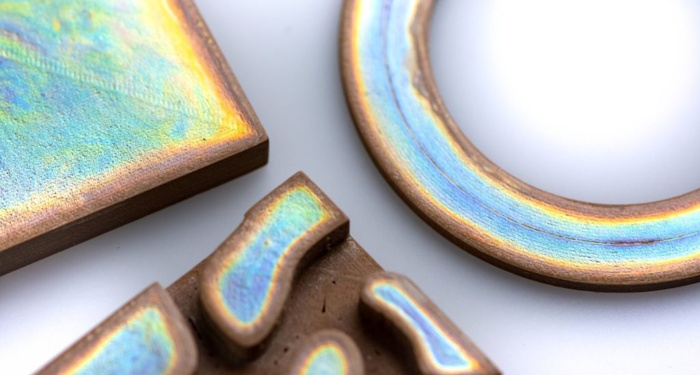
The end result of the research, the new glittering color is iridescent, meaning it changes depending on the angle of view. Similar colors have been made for decades from non-renewable natural resources, plastic, metal, and even toxic lead.
In nature, such colors are found, for example, in butterfly wings, peacock feathers, and the shell of a beetle. The structural color that is visible to the eye is created by the interaction of light and nanostructure.
The new wood-based color was created by chopping up tiny nanocellulose particles from wood, which after several processes organize into a nanostructure.
Fashion Circular Economy Award in 2024
Noora Yau took the sparkling wood material further into various experiments and applications and, from a design perspective, considered how color could be utilized in the built environment.
He also clarified the terminology of structural colors for other designers and artists. Previous research has focused mainly on understanding the physical principles of nanostructures, and the appearance and visual properties of the color have remained secondary.
Yau and Klockars wondered in which applications the fragile but hard wood colors would work best, and the crystals used in fashion and clothing came to mind. When the collaboration came Anna Semi, the threesome fucked in the Inspirer category of the Fashion Circular Economy Award at the 2024 I love me fair.
Startup commercializes glitter
There is a need for renewable, ecological glitter, as the EU has banned the sale of plastic loose glitter due to the microplastic problem.
"While working on my dissertation, I received a lot of inquiries from different industries, for example from fashion companies, architecture, and the automotive and furniture industries," Yau says.
Now, the startup company he founded, Shimber Oy, is aiming to commercialize the sparkling tree. The technology is in the process of being patented, and international customers are known.
“Our mission is to make high-value products that are not quickly thrown away after use, but that last and are preserved.”
Text: Päivi Ikonen and Elina Saarinen, Uusiouutiset
Photo: Valeria Azovskaya. The sparkling ecological color, based on nanocellulose structures, is iridescent, meaning it changes depending on the viewing angle. The innovation is being commercialized by a startup founded by Noora Yau.
More on the topic









Uusiouutiset newsletter