COMMERCIAL COOPERATION At the beginning of 2026, a two-year Wood Construction Development Platform project was launched, in which Eastern Finnish universities of applied sciences combine their expertise to develop wood construction. The project strengthens expertise,…
Meltwater treatment chain helps reduce water and soil pollution



COMMERCIAL COOPERATION
Although more attention has been paid to stormwater management in recent years, the treatment of snowmelt water is still minimal – even here in Finland, where meltwater is almost invariably a spring phenomenon.
In snowmelt areas, meltwater carries nutrients, solids, salts, and other pollutants and debris into water bodies and soil, which can degrade water quality and soil conditions. Winters becoming more variable and repeated thaw-freeze cycles emphasize the need to improve snowmelt water management.
Nature-based solution helps manage meltwater
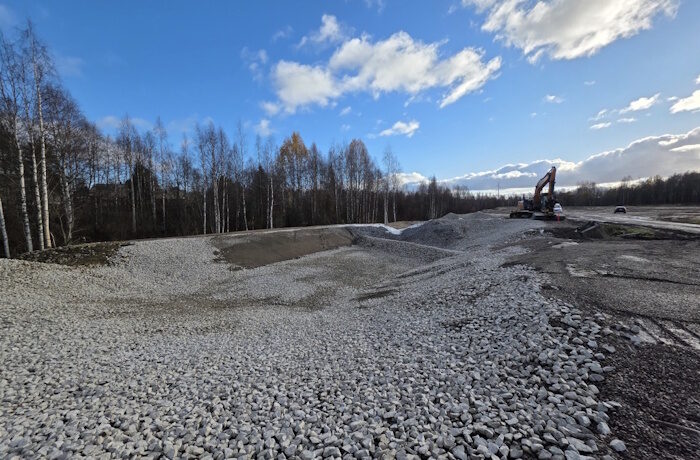
In Kajaani, the approximately 11,000 m² Pyykönpuro storage area processes an average of 30,000–50,000 cubic meters of snow annually.
Meltwater from the landfill site was previously discharged untreated into a nearby stream, which was reflected in the water quality, particularly in increased nutrient concentrations, turbidity and organic load, especially during the spring melt seasons.
A nature-based snowmelt treatment solution was implemented at the landfill site in the Horizon Europe-funded URBREATH project in autumn 2025. The system is based on a controlled and phased treatment chain that includes snowmelt collection, pre-treatment, filtration, absorption and controlled discharge.
Meltwater is directed through ditches, depressions and equalization areas to a centralized treatment system. This replaces the previous uncontrolled runoff with a clearly defined flow path.
In the pre-treatment stage, the settling tank and coarse filter elements remove debris, waste and coarse solids from the water before the finer treatment stages. The settling tank is designed to be easy to empty.
The core of the system is a nature-based solution based on biofiltration, where water is directed through a biofiltration basin and a sand-gravel filter structure. The aim at this stage is to retain fine solids and reduce the amounts of sodium and chloride, heavy metals and nutrients in the water, among other things. The aim is also to level out flows and reduce discharge peaks.
Exceptional weather conditions are reflected in the results
The first observations in the spring of 2026 indicate that no significant changes have yet occurred in water quality.
Exceptional weather conditions for Kainuu, i.e. a winter with little snow and an earlier than usual, very rapid melting of the snow, may have affected the operation of the system.
The system appears to be able to reduce some of the pollutants, but the overall impact on water quality remains limited for now, and further monitoring is required to determine its true effectiveness. For this reason, a monitoring campaign has been planned for the coming summer; in particular, monitoring water quality during storm events will provide more comprehensive information on the functionality of the solution.
In the URBREATH project Various nature-based solutions will be implemented in nine European cities. The aim is to identify solutions that will help cities adapt to a changing climate. The Finnish partners in the project are Kajaani University of Applied Sciences and the City of Kajaani.
Text: Henna-Mari Laurila, Ella Lukkari
Photo: City of Kajaani. In the Pyykönpuro landfill area in Kajaani, snowmelt water is treated using nature-based solutions.
More on the topic


Uusiouutiset newsletter