
Lounais-Suomen Jätehuolto (LSJH) outsources sorting operations for discarded textiles. As a result of the tender, quality assurance and sorting will be handled by the Sustainable Development Association from the beginning of next year,…
The nationwide textile collection network is thinning out – “The market for recycled fibers is not strong”




(To subscribers.) There is no recycling use for used textile fibers collected from households. The nationwide used textile collection network built in Finland is becoming increasingly rare. On the other hand, the reuse of clothing is increasing.
A hoodie with a small bleach stain on the sleeve. Jeans with a button that has come off.
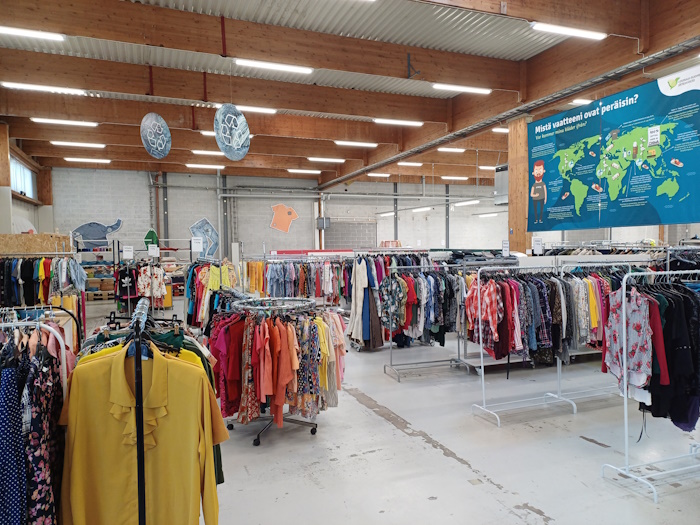
The Penkola side of the Lemppari store of the Southwest Finland Waste Management Company (LSJH) offers all kinds of slightly damaged clothing that is suitable for many people. The prices of the clothes sold under the theme "Repairing in Korean" are not outrageous: second-rate clothes are sold for two euros per kilo.
The Penkola concept has been the sales manager of Southwest Finland Waste Management Miira Ojanen according to really popular.
"The popularity shows that there is clearly a market for second-quality, reusable textiles. Those who are skilled at mending buy clothes for their own use, because many people cannot afford to buy new clothes at this time. Raw materials for crafts and art are also purchased from Penkola," Ojanen says.
Flea market vendors also use Lemppar and Penkola. Findings bought at a kilo price can be sold for up to seven times the profit.

More for reuse
The favorite clothes come from discarded textiles collected from households.
In principle, however, only waste should be put in the waste textile bin, i.e. clothing that you wouldn't dare wear even at the cottage. It's the wrong place for reusable clothing.
Nevertheless, there are always reusable items among them. Such clothing accounts for about 10 percent of discarded textiles.
LSJH has recently started to more carefully select reusable clothing from textile waste. While previously the company only collected the absolute gems, now it also saves clothing with minor defects for reuse.
However, this is a temporary solution.
"We are a waste organization. Our job is to recycle as material what is no longer suitable for reuse. I personally hope that other parties will also reuse second-rate material," Ojanen says.
Poor demand for recycled fibers
LSJH previously sorted the waste textiles into more than ten fractions and looked for partners and buyers for these fractions so that the textile fibers could be used as secondary raw materials and recycled.
Currently, LSJH sorts waste to recover those fractions for which there are realistic uses. No matter how carefully the sorting is done, it is difficult to find a market for the material sorted for recycling.
The sorting work is now focusing more on sorting textiles that are suitable for reuse.
“The textile market is not doing well,” Ojanen summarizes.
There is therefore not enough demand for recycled fibers for any brand to make clothing or home textiles from them.
Although clothing brands have talked about responsibility and implemented recycled material pilots, a large-scale circular economy leap has remained on the shelves. Only about one percent of textile fibers still end up in a closed loop, or textile-to-textile recycling.
"Because the end is not pulling, the beginning of the cycle, i.e. collection and sorting, or any other stage in the cycle, cannot operate profitably," Ojanen sums up.

LSJH is currently working on development projects with Finnish fashion designers to utilize textile materials. Development projects are also underway for recycling other than textile-to-textile recycling. The company is developing In the tExtended project from miscellaneous textile waste material, for example, non-woven products for green construction.
A bundle of banknotes on top of a bale of textiles
Natural fibers such as linen or cotton are reasonably recyclable if they do not contain hard parts. Cotton textiles LSJH directs to fiber opening and further to chemical dissolution, where the cotton is made into recycled fibers for use by clothing brands.
LSJH prefers the chemical recycling route because mechanical recycling routes are not very efficient, Ojanen says:
“We could deliver the material to a mechanical recycler, but we would have to pay for them to accept the material.”
There are no large-scale yarn spinning or fabric weaving plants in Finland that could use mechanically processed recycled fiber. The raw material should be exported to Central Europe, but there is an oversupply of raw material there anyway.
The oversupply has been caused by the fact that EU regulations require member states to start collecting residents' textile waste separately. Textile waste flows in Central Europe are abundant.
Because clothing brands are not yet utilizing recycled raw materials in the same volume, European fiberization plants are suffering from a lack of orders.
Textile material waiting to be recycled is now sitting in warehouses all over Europe.
Textile section of EuRIC, the European recycling industry umbrella organization published a petition in March to boost the circular economy. In its manifesto, the chamber stated that the European textile collection and recycling sector is in crisis due to rising costs and a lack of demand for recycled raw materials. In addition, ultra-fast fashion is making operations even more difficult.
Out of the national collection network
Lounais-Suomen Jätehuolto has been promoting the circular economy of textiles for over 10 years.
LSJH's intention was to build a large textile waste sorting plant in Topinpuisto, Turku, which could have promoted recycling on a large scale.
The company built a collection and sorting network for household waste textiles in Finland in cooperation with municipal waste facilities and third sector operators. Finland achieved nationwide coverage of separate collection ahead of schedule.
Finnish end-of-life textile collection covered a total of almost 2023 municipalities or regional waste facilities in the peak year of 30. The end-of-life textile collection covered more than 95 percent of the area of mainland Finland.
LSHJ Project Manager Aki Honkanen reports that in the best year, well over 2600 tons of discarded textiles were collected, of which just under 800 tons of material ended up for material sorting at LSJH.
Now the amount has been halved. LSJH will only receive about four hundred tons of waste textiles.
Municipal waste facilities have one after another dropped out of the national collection network and are now handling their separate collection obligations in their own areas with their own arrangements. The network led by LSJH now covers about 35 percent of Finland.
Ojanen understands the waste facilities that have withdrawn from cooperation. Separate collection of textile waste is expensive and difficult. It requires a lot of work and resources, and the end result is not necessarily desirable in the current market situation: After all the work, textile waste may still have to be incinerated, because there are simply not cost-effective recycling applications for all materials.
“This situation can be beautifully called the pre-commercial phase,” Ojanen ironically says.
Municipalities have no role in producer responsibility
In addition, the EU is drafting a Waste Framework Directive that will shift responsibility for future textile waste streams to the producer. The role of municipalities in the future is still unclear.
In an uncertain situation, LSJH has been forced to abandon the investment project for the Topinpuisto plant.
"Despite everything, LSJH's vision has not changed: We want to solve the challenges of the circular economy of Finnish textile waste. We will continue this work and try to find partners and build development projects that create new recycled products for consumers," says Ojanen.
Text: Elina Saarinen/ Uusiouutiset-magazine
Photo: LSJH. There is starting to be an oversupply of textile material awaiting recycling on the European market.
More on the topic







Uusiouutiset newsletter