
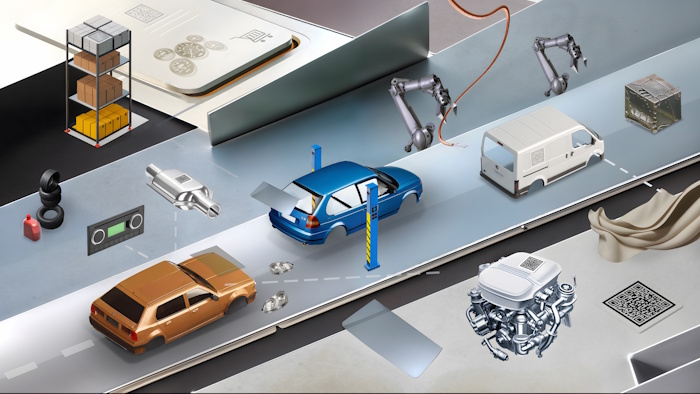
(For subscribers.) Turku Peltola is leading the way to a new kind of automotive industry. There are such big changes happening in car recycling that the transformation could be compared to a century ago…
Dismantling an electric car requires knowledge, skills and instructions
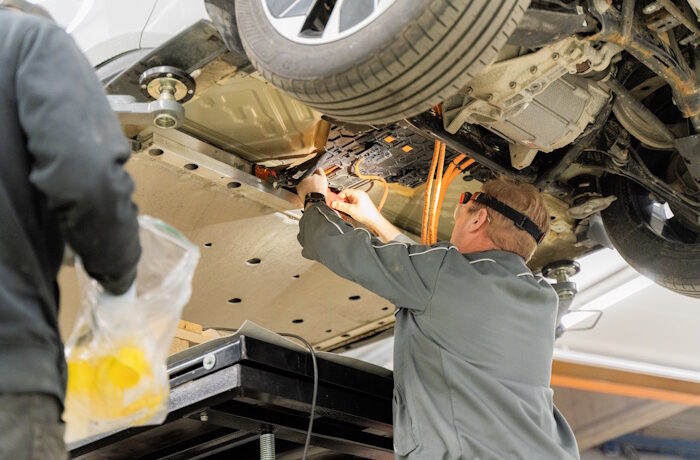



When an end-of-life electric car is to be dismantled, model-specific instructions are needed to remove the battery, which are often not available. The EU's circular economy regulation for end-of-life vehicles will require vehicles to share a digital circular economy passport to help with their lifecycle. What is recorded in the passport is crucial for the dismantler.
Turku University of Applied Sciences (Turku AMK), together with Turku Vocational Institute (TAI) and companies in the field, has been developing circular economy-based operating models and solutions for car dismantling for several years. A car dismantling line has been built on TAI's premises, where around a hundred internal combustion engine cars have been dismantled and their dismantling instructions have been developed.
There are no similar instructions for dismantling electric cars yet, because there are still few electric cars that have reached the end of their life cycle.
In September 2026, at the Autocirc office in Nurmijärvi, experts and students from Turku University of Applied Sciences and TAI, together with Autocirc personnel, performed an electric car disassembly demonstration as part of Car dismantling line 2.0 project.
Unload safely
The dismantling demonstration emphasized the importance of design and the significance of manufacturers' dismantling instructions. The dismantlers utilized the manufacturer's instructions to ensure that the parts were dismantled intact and reused.
The importance of the design was emphasized from a safety perspective, as the battery must be de-energized and safely removed.
The students' role was to collect data, time the work steps, and document the demonstration to ensure reliable and comparable research material.
In addition to educational institutions, members of the car dismantling ecosystem were present at the Nurmijärvi site, as the demonstration also served as an educational event. The electric car was dismantled for spare parts, with the aim of diverting as many of the parts as economically feasible for reuse.
Over 130 parts intact
The car was dismantled down to the frame – only the right front door, which had crash damage, was left in place. A total of 136 parts were removed from the car intact, which are being sold as spare parts.
19 kilograms of copper, 52 kilograms of plastic and a 440 kilogram frame were recovered for recycling. In total, 1330 kilograms of material were removed from the car.
In the future, Autocirc and the industry more broadly plan to utilize more automation and artificial intelligence in the dismantling phase. These could help eliminate current time-consuming and sometimes inefficient work steps, such as moving parts from one place to another and pricing and listing parts for sale.
Improvements and new requirements are coming from the EU for storing and sharing vehicle lifecycle data, but even before that, the parts and valuable materials in cars that are suitable for use as spare parts must be made available. This goal will be continued at Turku University of Applied Sciences together with companies operating in the car dismantling ecosystem.
The text was written as part of the Car Dismantling Line 2.0 project, co-funded by the European Union.
Text: Tina Niitynpää, Eerika Rentto, Nani Pajunen and Vesa Törmäkangas.
Tina Niitynpää and Eerika Rentto are engineering students in the Department of Energy and Environmental Technology at Turku University of Applied Sciences. Nani Pajunen and Vesa Törmäkangas are experts at Turku University of Applied Sciences.
Photo: Sini Saarinen, Turku University of Applied Sciences
More on the topic










Uusiouutiset newsletter