
The European Parliament has approved an amendment to the Waste Framework Directive. The decision introduces for the first time EU-wide producer responsibility for textiles. The Waste Framework Directive obliges textiles to be placed on the EU market…
Artificial intelligence estimates whether your used clothing still has value – TexMat collection machine could revolutionize the second-hand clothing market



Do you find it difficult to assess when your old clothes would still be suitable for reuse or sale on the second-hand market?
A new innovation promises to help consumers with their evaluation work.
The University of Vaasa, VTT, the Helsinki Metropolitan Area Recycling Centre and Emmy Clothing Company are developing TexMat sorting machine, which is based on artificial intelligence and a digital product passport.
A digital product passport alongside a washcloth
The consumer does not have to sort clothes based on their condition or suitable store location, but can bring all the clothes to one place at once, to the TexMat collection machine.
TexMat sorts the clothes brought in by consumers into either resaleable or textile recycling if there is no longer any resale value.
"VTT is developing artificial intelligence-based imaging and data processing technology for the TexMat collection machine that utilizes digital product passport information, which can be used to determine the condition of the garment and thus its suitability for resale," says VTT's principal researcher coordinating the project. Elina Ilen says.
A digital product passport containing more comprehensive product information than the current washcloth will be introduced in the EU in the near future.
The product passport includes, among other things, the brand, materials used, product category, size, and date of manufacture – in other words, all information that has an impact on the resale value of the product.
Supports expanding producer responsibility
TexMat is revolutionizing the second-hand market because it simplifies and automates the logistics of collecting and sorting clothing.
“The TexMat collection machine aims to ensure that the vast majority of textiles are collected for reuse or recycling. This strongly supports the EU’s upcoming expanded producer responsibility directive", where clothing manufacturers, importers and distributors will also be responsible for collecting, sorting, reusing, recycling and waste management of products," says Ilén.
Aiming to revolutionize clothing collection and resale in Europe
The task of the research and development work carried out at the University of Vaasa is to ensure that the business model becomes profitable for the operators and that consumers have an interest in bringing their clothes to the collection machine.
"The TexMat collection machine can improve business profitability, as different types of second-hand retailers can receive from the system exactly the products their customers want, for example based on brand, product category, size or even color," says senior researcher Erwan Mouazan from the University of Vaasa.
Hassle-free for the consumer
Manual sorting of products for sale and recycling is eliminated with the TexMat system.
“This is hassle-free for the consumer. After selling the product, retailers automatically refund the proceeds to the consumer. This is unprecedented and enables an increase in the collection rate of textiles and also increases the resale market,” says Ilén.
Emmy Clothing Company and the Helsinki Metropolitan Area Recycling Centre are participating in the validation of the TexMat collection machine in its real-world environment.
“TexMat represents the kind of systemic innovation that Europe needs. By making the textile cycle effortless for consumers and profitable for businesses, we can finally move from intention to impact. Emmy is proud to share her practical expertise in resale and circular economy business models to help build a future where every garment gets a second life,” CEO Sienna Kruk Emmy from Clothing Company says.
Tests also in Spain
The trials of the international TexMat project will be carried out in Spain as well as in Finland.
There is a growing problem with textile waste collection in Europe. Each citizen produces around 16 kilograms of textile waste per year, of which only 4 kilograms end up in material recycling or reuse. The remaining 11 kilograms end up in landfill or incinerated with mixed waste.
The Helsinki Metropolitan Area Recycling Centre is delighted to have the opportunity to develop the circular economy of textiles across Europe.
"We have been involved in the second-hand trade for over 30 years and have seen the growth of the industry and especially the growth of challenges related to textiles. In the TexMat project, we get to spar with leading European players and bring our expertise to contribute to the future development of the textile circular economy," says Sami Leppänen, customer service manager at the Recycling Center.
In total, the TexMat collection machine is being developed by 14 partners from seven EU countries. The European Union's Horizon Europe research and innovation program is funding the project with 6,25 million euros until spring 2029.
Text: Uusiuutisten editorial team
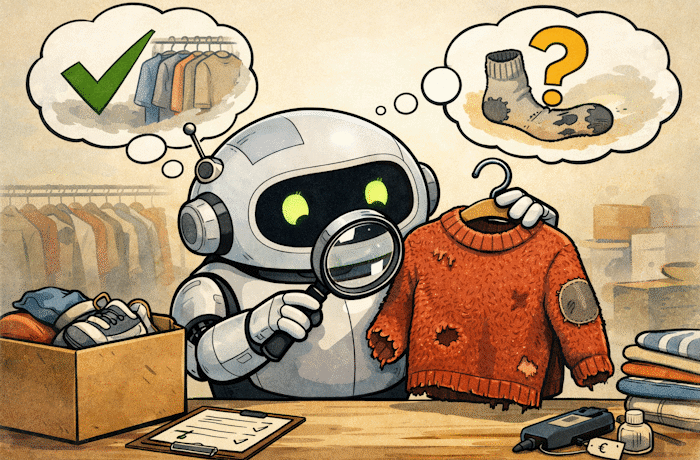
Image: ChatGPT AI. The image developed by artificial intelligence symbolizes that artificial intelligence-based image recognition can in the future help determine whether used clothing still has market value.
More on the topic










Uusiouutiset newsletter