
New urban development has progressed in Finland with the help of three UUMA projects. Now there are plans to start a fourth UUMA project. A longer-term continuation of the work to promote new urban development is also being considered, UUMA…
The UUMA5 program accelerates low-carbon construction and the circular economy in cities



The UUMA5 program supports cities in promoting low-carbon construction and the circular economy. Eight cities are participating in the program, and it provides studies and guidelines that help cities implement environmentally friendly solutions in their procurement and in the guidance of design and implementation. But what progress has already been made in urban redevelopment? And how do cities plan to develop it in the future?
The UUMA5 program is a collaborative forum that promotes new land development and shares best practices. It includes Espoo, Helsinki, Kerava, Kuopio, Lahten, To Tampere, Oulu ja Cities in Vantaa.
Cities have taken significant steps towards low-carbon construction and the circular economy. Key measures include land management through project-to-project collaboration and the planning and permitting of temporary recycling areas, which reduces the need for transportation and the resulting carbon dioxide emissions.
Local coordination of construction and demolition work can save natural materials and reduce the need for transportation and environmental impacts. Other circular economy opportunities include the use of low-carbon binders in stabilization and the use of recycled materials in landscaping. All of this saves materials and promotes a more sustainable urban environment.
Circular economy opportunities are particularly exploited in growing media used in green construction. This saves materials and promotes a more sustainable urban environment. In addition, local material producers, such as local industry, can act as important suppliers of circular economy materials.
Towards a more efficient circular economy through UUMA cooperation
The UUMA programme (programme phases 2-5) has been implemented since 2012, and significant results have been achieved over the years. The activities of the cooperation forum have strengthened the position of redevelopment and shown that the circular economy requires effective cooperation and the collection and sharing of information.
“In order to maximize the benefits of recycled materials, different actors – including designers, developers, contractors, material suppliers, authorities, and cities and municipalities – must work closely together. When circular economy solutions are integrated into construction, they create new business opportunities for Finnish companies. At the same time, more efficient utilization of resources brings national economic benefits, for example through cost savings and better use of materials,” says the chair of the UUMA program. Mikko Suominen From the city of Helsinki.
Kerava develops new land development through experiments and cooperation
In Kerava, the promotion of new land construction is reflected in concrete experiments and the development of the reuse of materials. The city has carried out growth substrate experiments that have utilized biochar and horse manure. In addition, the use of used sanding sand in the dividing layer of lower-class road surfaces is being tested, and the reuse of used asphalt crushed stone in the structural layers of the street is being planned.
Active cooperation is being carried out between the city's various actors to identify recyclable aggregate fractions and find suitable storage and utilization sites for them. Kerava also has personnel who are committed to material trials and sharing their results in design, construction and maintenance.
"In Kerava, we want to boldly try out new circular economy solutions in practice. Cooperation between different actors and open sharing of information are key when developing more sustainable construction," says the Planning Manager of the City of Kerava's Infrastructure Department, Mariika Lehto.
The City of Helsinki is investing in new urban development
Principles of utilization of excavated soil, aggregates and recycled materials and, among other things, the introduction of the Mass Tool have brought clear added value to the soil management of the City of Helsinki. The Mass Tool provides a unified platform for planning the use of excavation masses and aggregates, collecting as-built data and reporting. At the end of 2024, the tool was further expanded when UUMA materials were also added. This expands the tool's applicability, especially from the perspective of sustainable and resource-wise construction.
"We have access to up-to-date and comparable data, which can be used to plan the use of excavated materials and aggregates more systematically and resource-efficiently than before. The tool supports us not only in managing costs and environmental impacts, but also in ensuring that different actors can act on the basis of shared, reliable information. Our experience shows that when information is compiled and easily accessible, construction processes can be genuinely developed towards more sustainable and climate-smart practices," says Mikko Suominen, from the City of Helsinki.
The mass data collection targets set for 2024 were achieved and partially exceeded. Data analysis is ongoing, and will be used to develop the planning process and the current state of mass coordination.
Helsinki uses emissions data in street projects
The City of Helsinki is developing the use of emission data in street and park planning, the consideration of emissions in decision-making, and the reporting of generated emissions. Since 2024, Helsinki Street Planning has conducted further analysis of the cost and emission calculations of some planning projects.
It is natural that the costs per square meter and specific emissions of streets undergoing renovation and new ones differ significantly. On a street undergoing renovation, the possibility of influencing emissions is also less, because the proportion of asphalt concrete and paving is so high, and there is no alternative to them.
On new earth-based streets, the costs of street structures are many times higher than on streets undergoing basic renovation, and emissions increase roughly linearly with the cost per square meter of the street. On the other hand, the share of street base reinforcements and technical structures in emissions is typically considerably high. There is a clear relationship between street costs and emissions. For every euro invested in street infrastructure, 0,2-0,4 kg CO₂e of carbon dioxide emissions are generated. If the construction of a street requires expensive base reinforcements or technical structures, the impact is visible not only in the city's investment program but also in emissions.
Mass data standardization project underway
The City of Helsinki, the Finnish Transport Infrastructure Agency, the Region of Uusimaa and the cities of Tampere, Oulu, Lahti and Vantaa have launched a mass data standardization project. The aim is to find a solution to the fact that data is scattered across different systems and that there is no uniform method for compiling and reporting mass data. The goal is to standardize the data used for reporting and enable automation of systems.
The project aims to determine, among other things, whether to use cubic meters or tons for reporting, the conversion factors between the two, and the terms used in data collection and reporting. The goal is to standardize the data used for reporting, thereby enabling automation of systems and consistent and transparent reporting.
By investing in data collection and quality, we will achieve sufficient data volume to make predictions, coordinate masses, and create solutions that promote the circular economy. This will also enable us to report on them better and more reliably.
More information:
UUMA program for new land development
Principles of utilizing excavated soil, aggregates and recycled materials in earthworks (pdf)
Text: UUMA Programme for New Country Construction, Tiina Rintanen and Marjo Koivulahti. This article was originally published on the UUMA5 program website. Republished with permission.
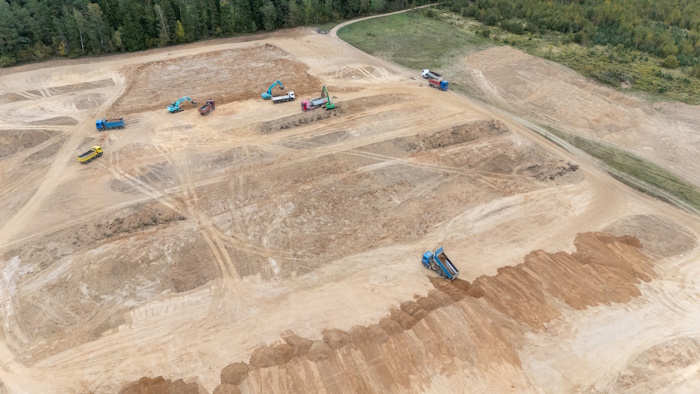
Image: Adobe Stock. Local coordination of construction and demolition work can conserve natural materials and reduce the need for transportation and environmental impacts.
More on the topic




Uusiouutiset newsletter