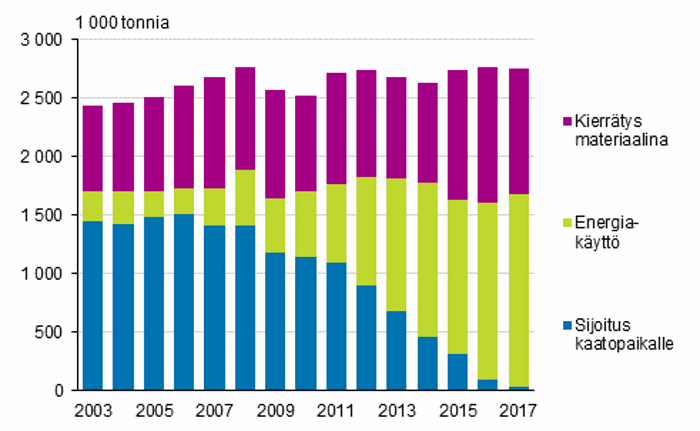
In Finland, up to 2017 percent of municipal waste was recycled in 99. Only one percent, or less than 26 tons, of municipal waste went to landfill. Landfill…
Separate collection of municipal waste became more efficient and the recycling rate improved
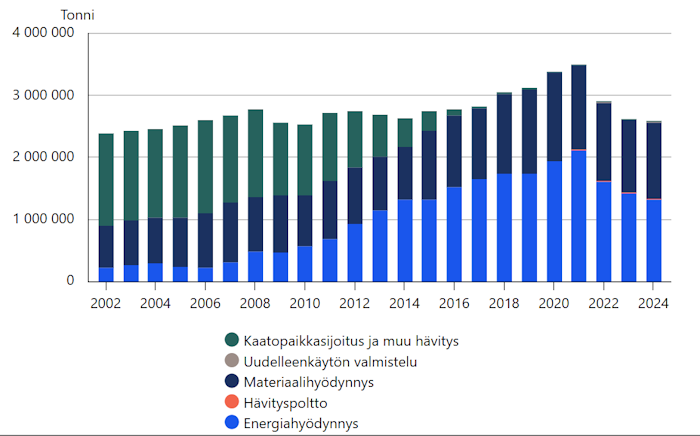



Recent municipal waste statistics from 2024 show that the positive trend in waste recycling continues.
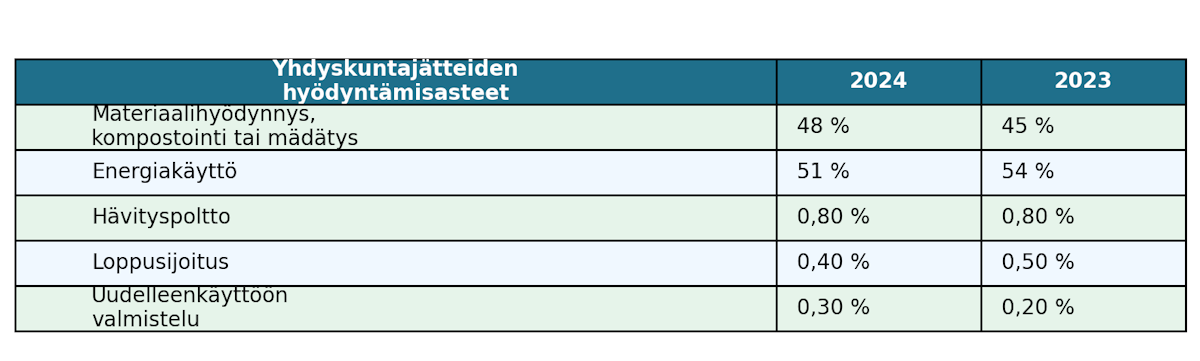
The material recycling rate for municipal waste increased to 48 percent from 45 percent the previous year. The figure includes both the utilization of waste as material and composting and digestion.
Statistics Finland published municipal waste statistics at the end of January 2026. The data concerns the year 2024.
The recycling rate has now developed in the right direction for several years in a row. However, there is still some way to go to reach the targets: The recycling rate for municipal waste in 2025 should be 55 percent.
A larger proportion of waste is collected separately
Statistics show that improved separate waste collection has helped increase the recycling rate.
An increasing proportion of waste is now separately collected recyclable waste. The share of separately collected waste in the total amount of waste increased to well over half (52%) in 2024.
As late as 2023, 50 percent of separately collected waste was recovered. At that time, 46 percent of all waste was still mixed waste.
99% of mixed waste is sent to incineration.
Approximately 51 percent of all municipal waste was directed to energy recovery in 2024. In 2023, the energy recovery rate was 54 percent, so the share of energy use has decreased and the share of recycling has increased.
Biowaste well collected
The separate collection of biowaste was most effective. 35 percent of all separately collected municipal waste was biowaste.
The amount of biowaste also increased in terms of tonnage. Almost 60,000 tonnes more of separately collected biowaste was recovered than in 2023.
The separate collection obligation for biowaste and the home composting obligation came into effect in July 2024. The new obligations brought hundreds of thousands of properties into the scope of collection or composting.
Separately collected biowaste can be composted or digested in biogas plants. In addition to biowaste, some wood waste is sent for composting and digestion, for example as a support material for compost, as well as other separately collected organic waste.
The amount of composted and digested municipal waste increased to a total of 460,000 tonnes, an increase of approximately 12 percent compared to the previous year.
Separate collection of plastic waste did not increase
Although the separate collection of plastic packaging has increased in Finland, less separately collected plastic waste was recovered in 2024 than in 2023.
The largest drop was in the amount of electrical and electronic waste, which fell by almost 20,000 tonnes from the previous year, to approximately 68,000 tonnes.
Less for energy, more for recycling
The growth in material recycling is mainly explained by the fact that as much as 21,7 percent of waste in the other and unsorted category was now recovered as material.
A year earlier, only seven percent of waste in this category was utilized as material.
Chief Actuary of Statistics Finland Martti Kujansuu indicates that more recovery operations have been carried out on waste belonging to this category than before, which increases the proportion of waste material recovery.
A closer look at the waste codes in the category reveals that more waste generated from cleaning streets and drains, such as sandblasting sand and sludge, has been used as material than before.
Kujansuu points out that waste statistics often show phenomena that only appear for one or two years. For example, the increase in the use of sandblasting sand may be the result of a temporary pilot project that occurred at the time of the review.
Total waste volume decreased
In 2024, 456 kilograms of municipal waste were generated per person per year.
Overall, Finland generated significantly less municipal waste in 2024 than in the previous year. The total amount of waste was 2,57 million tons, compared to 2,61 million tons in 2023.
The decrease in the amount of municipal waste is mainly explained by the decrease in the amount of municipal waste collected from private services such as shops and offices.
"The decrease in the amount of municipal waste is the combined effect of several factors. Companies have fared slightly worse in 2024 than the previous year, there have been more bankruptcies and turnover has fallen. This reduces the amount of waste generated. On the other hand, remote working can also have an impact on the amount of waste in restaurants and offices," Kujansuu explains.
Text: Elina Saarinen, Uusiouutiset
Graph: Statistics Finland. Municipal waste treatment in 2002-2024.
More on the topic






Uusiouutiset newsletter