(Tilaajille.) Turun Peltola näyttää tietä uudenlaiseen autoteollisuuteen. Autojen kierrätyksessä on tapahtumassa niin isoja muutoksia, että murrosta voisi verrata aikaan satakunta…
Circularity meets creativity: How Turku is testing new ways to tackle everyday waste



Kaupallinen yhteistyö
Turku has committed to becoming climate neutral by 2029: one year ahead of the member cities of the European Union’s Cities Mission, and 21 years ahead of the EU’s own 2050 target.
Through the European project Creative Circular Cities (CCC), Turku has spent the past three years building bridges between circularity, creativity, and community engagement. The project explores whether artists, designers and creative methods can help residents relate differently to waste, turning circularity from an obligation into something people actively want to be part of.
The separate collection of biowaste poses a challenge to many municipalities. Looking to explore alternative approaches to this challenge, the local waste management company Lounais-Suomen Jätehuolto Oy (LSJH), in partnership with the CCC project, launched an open competition inviting artists, designers and citizens to propose creative approaches that would motivate people to sort their household biowaste. 34 ideas from across Finland were submitted, covering three main categories: illustrated or video concepts, physical solutions for the biowaste bin itself and technical or gamified approaches
Two proposals for further development
The jury, formed of professionals from LSJH and the CCC project, selected two proposals to be further developed in the following months:
● BioBox (submitted by Kaisa Nurminen and her working group) – an artistic biowaste box designed for public spaces, allowing people to witness the compost process through the transparent walls.
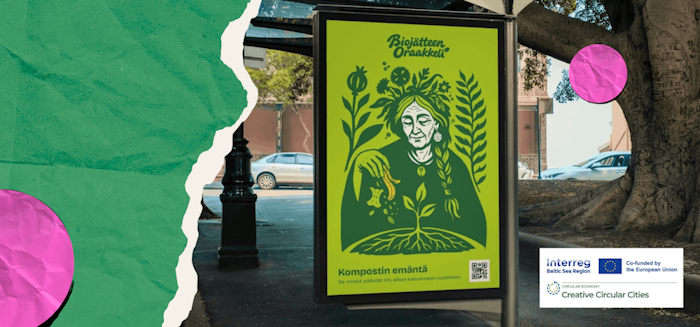
● Biojätteen Oraakkeli (submitted by Anniina Pohjola) – a visual concept using creative cards to inspire discussions and support education processes around biowaste sorting, inviting people to explore alternative possibilities for managing waste.
With a €3000 grant offered by HUMAK University of Applied Sciences, the main organizer of the competition, each winning team will continue working with LSJH to expand and finalize their concepts, and present them in October 2026, when LSJH can decide to move forward with either one or both of them. ”What’s exciting about this competition is seeing climate strategy actually take shape in people’s hands,” says Markus Suomi, Senior Lecturer at the Humak University of Applied Sciences.
Microcourse and infographic help others
The competition is the latest milestone in the agenda that Turku has built through the CCC project. A 2025 Idea Incubator run by HUMAK brought artists, businesses and circular economy experts together to co-create ideas later tested at the ReTurku Circular Economy Carnival – a two-neighbourhood pilot led by Valonia, that drew over 1,000 participants across more than 30 events.
To help other organisations replicate the approach, HUMAK produced a free online microcourse covering the full incubator methodology and an interactive infographic summarising the key steps for designing a cross-sectoral idea incubator.
This type of cross-sector collaboration now continues through a recurring Co-creation Arena that gathers representatives from culture, circular economy, sustainability, citizen engagement and business every two to three months to exchange ideas and build a community of practice around circularity. On the digital side, two platforms that help connect citizens with urban circular economy services – Superhood Oy’s ”CircularCity” and INC Innovation Center’s ”ReMatch” – are being tested in Turku as part of CCC’s Pre-Commercial Procurement (PCP) process.
Six municipalities, same question
The city is also looking to carry the approach forward: a Citizen Engagement Card Game, developed by HUMAK from the Carnival’s experience, was piloted with Kiel at the Urban Future – The Better Cities event in Ljubljana in March 2026, exploring ways to connect unused resources with community needs and turn circular economy ambitions into everyday practice though the involvement of citizens.
The game could become a useful tool for other organizations, municipalities and communities that look to address local challenges in similar ways.
Turku’s explorations are echoed across the other five municipalities involved in the Interreg – Baltic Sea Region project as well: Aarhus, Gdynia, Kiel, Riga, and Tallinn. Every city in the project is tackling the same question: How do you get circularity out of strategy documents and into people’s daily routines? While there’s no singular answer that fits all contexts, each of these pilot initiatives can offer valuable insights and practices that others can build on.
About Creative Circular Cities
Creative Circular Cities (CCC) is a transnational project co-funded by the Interreg Baltic Sea Region Programme and the European Union. The project explores how culture and the creative industries can help cities move from linear consumption to circular lifestyles. Across six Baltic Sea Region cities — Tallinn, Aarhus, Gdynia, Kiel, Riga and Turku — CCC develops and tests tools, models and local activities that connect circular economy with creativity, citizen engagement, business development and policymaking.
In Turku, CCC is implemented with the support of Valonia (the City of Turku’s sustainability service), Humak University of Applied Sciences, and Lounais-Suomen Jätehuolto (LSJH).
Aiheesta lisää

Uusiouutisten uutiskirje